
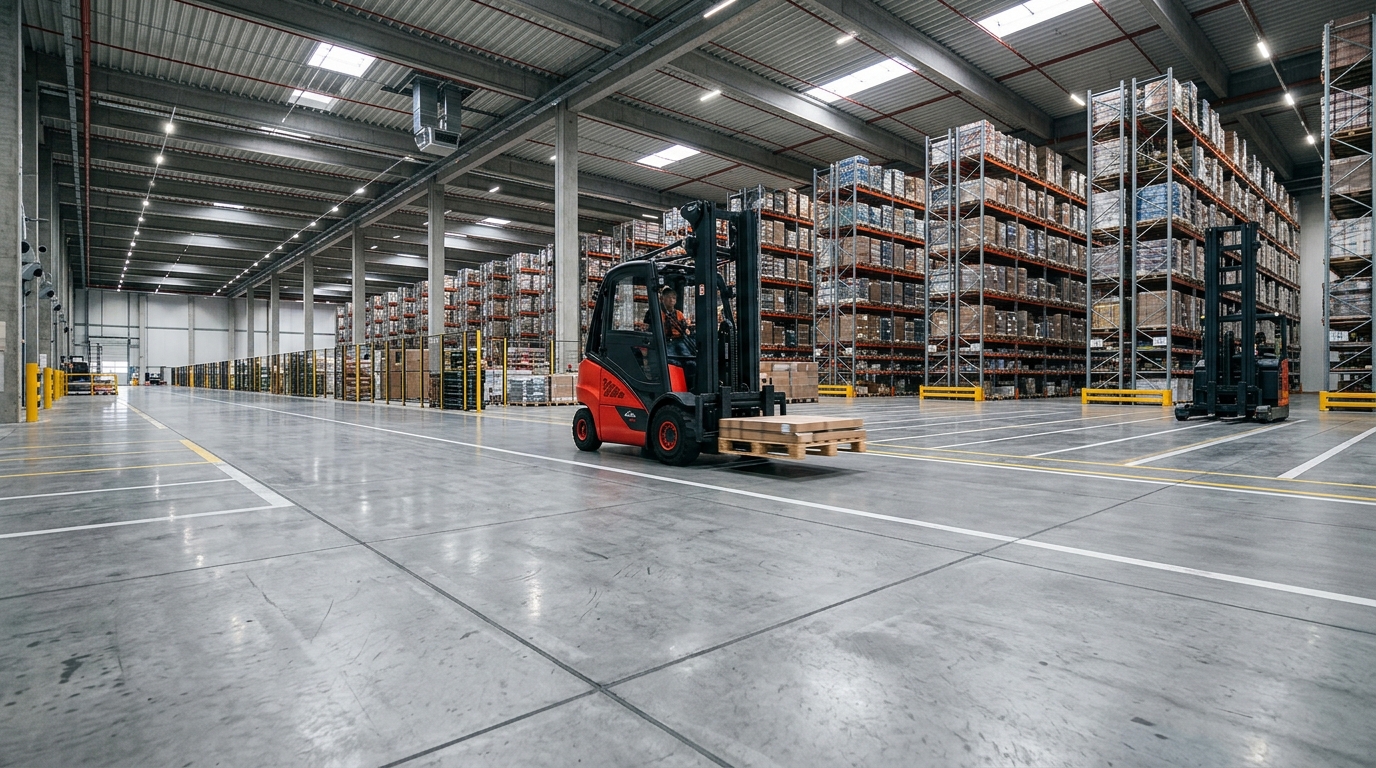
Selecting floor tiles for factories and logistics facilities requires balancing dynamic load-bearing capacity, impact resistance, flexural strength, and chemical tolerance. Unlike commercial or residential spaces, industrial facilities operate under continuous heavy machinery movement, intense forklift traffic, and static rack loading. High-performance industrial tiles and engineered precast elements provide the structural integrity needed to prevent subfloor degradation, cracking, and costly operational downtime.
Key Performance Indicators for Industrial Floor Tile Selection
When specifying floor tiles for high-throughput logistics hubs or manufacturing plants, standard visual metrics are secondary to mechanical performance. Facilities handling high-tonnage goods must prioritize compressive strength and abrasion resistance to ensure long-term reliability.
- Compressive and Flexural Strength: Industrial tiles must withstand heavy static point loads from high-density pallet racking as well as high dynamic loads generated by fully laden forklifts and reach trucks.
- Abrasion and Impact Resistance: Repeated friction from hard-wheeled material handling equipment causes surface wear. Precast and heavy-duty tiles engineered with high-density mineral aggregates prevent dusting and erosion.
- Chemical and Stain Resistance: Oils, hydraulic fluids, battery acids, and industrial cleaning agents can penetrate porous surfaces, compromising structural bonding over time. Surface density and low absorption rates are critical.
- Slip Resistance and Safety: In wet zones or packing areas, anti-slip surface textures protect workforce safety while allowing efficient sanitation.
Heavy Dynamic Loads vs. Static Loads: Calculating Subfloor Stress
A primary failure point in industrial flooring stems from underestimating dynamic impact forces. While static loads remain constant under storage racks, dynamic loads move across the floor, exerting shear stress and vibration at tile edges and joints.
Forklifts equipped with solid polyurethane or steel wheels transfer intense localized weight onto floor tiles. If the tile sub-base lacks uniform support or if the tile material lacks adequate flexural modulus, fractures develop rapidly. Decision-makers should evaluate technical metrics such as breaking strength and water absorption percentages specified in our Technical Specifications Table before finalizing facility layout specifications.
Comparing Industrial Flooring Materials: Precast Tiles vs. Epoxy and Resin Coatings
Choosing between engineered heavy-duty precast tiles, poured concrete, and epoxy coatings involves assessing initial installation investment against total life-cycle costs.
| Criteria | Heavy-Duty Precast Tiles | Epoxy / Polymer Coatings | Standard Monolithic Concrete |
|---|---|---|---|
| Impact Resistance | Exceptionally High | Moderate (Prone to chipping) | Moderate |
| Load Bearing Capacity | Extreme Dynamic & Static | Depends on Base Slab | High (Subject to surface dusting) |
| Maintenance & Repair | Sectional / Individual Tile Replacement | Requires Full Area Resurfacing | Complex Structural Patching |
| Chemical Resistance | High Surface Density | High (When Undamaged) | Porous (Requires Sealer) |
| Operational Lifespan | Decades under severe use | 3 - 7 Years under heavy traffic | 10 - 15 Years |
Industrial Joint Planning and Subfloor Preparation
Proper joint design is as critical as tile selection. Industrial floor joint planning ensures that expansion, contraction, and structural movement are accommodated without causing edge spalling along tile lines.
Subfloor moisture must also be managed during installation. Applying joint sealants or tile adhesives over damp subfloors without adequate moisture vapor barriers can lead to bond failure and tile delamination. Detailed guidance on surface preparation, curing times, and environmental tolerances can be found in our Technical Documents section.
How Precast Building Elements Support Modern Logistics Infrastructure
Beyond main aisle tile laying, modern logistics facilities rely on integrated structural components to manage vehicular movement and loading docks. Utilizing precast concrete perimeter units, curb elements, and customized structural blocks creates seamless transitions between indoor floor surfaces and outdoor loading areas.
Integrating standardized precast elements into facility design ensures uniform load distribution across dock levellers, ramp aprons, and high-impact perimeter zones where standard masonry frequently fails under heavy logistics traffic.
Frequently Asked Questions
Can joint grouting be applied on damp subfloors in industrial zones?
Applying traditional cementitious or epoxy joint grout directly onto saturated or excessively damp subfloors compromises bond strength and can cause efflorescence or debonding. Moisture vapor emission rates must be measured prior to installation, and moisture-tolerant primers or specialized breathable grouts should be specified when damp conditions exist.
How do forklift wheel types affect floor tile wear?
Hard rubber and polyurethane wheels spread load weight over a small contact area, generating high point pressure and micro-friction. Pneumatic tires distribute weight more broadly. Facilities operating hard-wheeled vehicles require tiles with higher surface hardness and impact resistance scores to prevent grooving and micro-fractures.
What causes tile edge spalling in high-traffic logistics aisles?
Edge spalling occurs when floor movement joints are improperly placed, grout joints are left unfilled, or tile edges sit unevenly above adjacent tiles (lip height). When hard forklift wheels pass over uneven joints, point impact forces chip the unbacked edges of the tiles.
Designing Your Facility Floor Plan for Long-Term Operational Efficiency
An optimal industrial floor system combines robust tile engineering, precise joint planning, and quality subfloor preparation. Selecting the right flooring spec early in the architecture phase eliminates costly downtime, reduces equipment maintenance caused by uneven surfaces, and ensures compliance with occupational safety standards.
For facility managers, project engineers, and corporate planners seeking custom load calculations or specific product recommendations for upcoming facility builds, contact our engineering team directly through our Contact and Technical Support Page to request a technical consultation or project quotation.