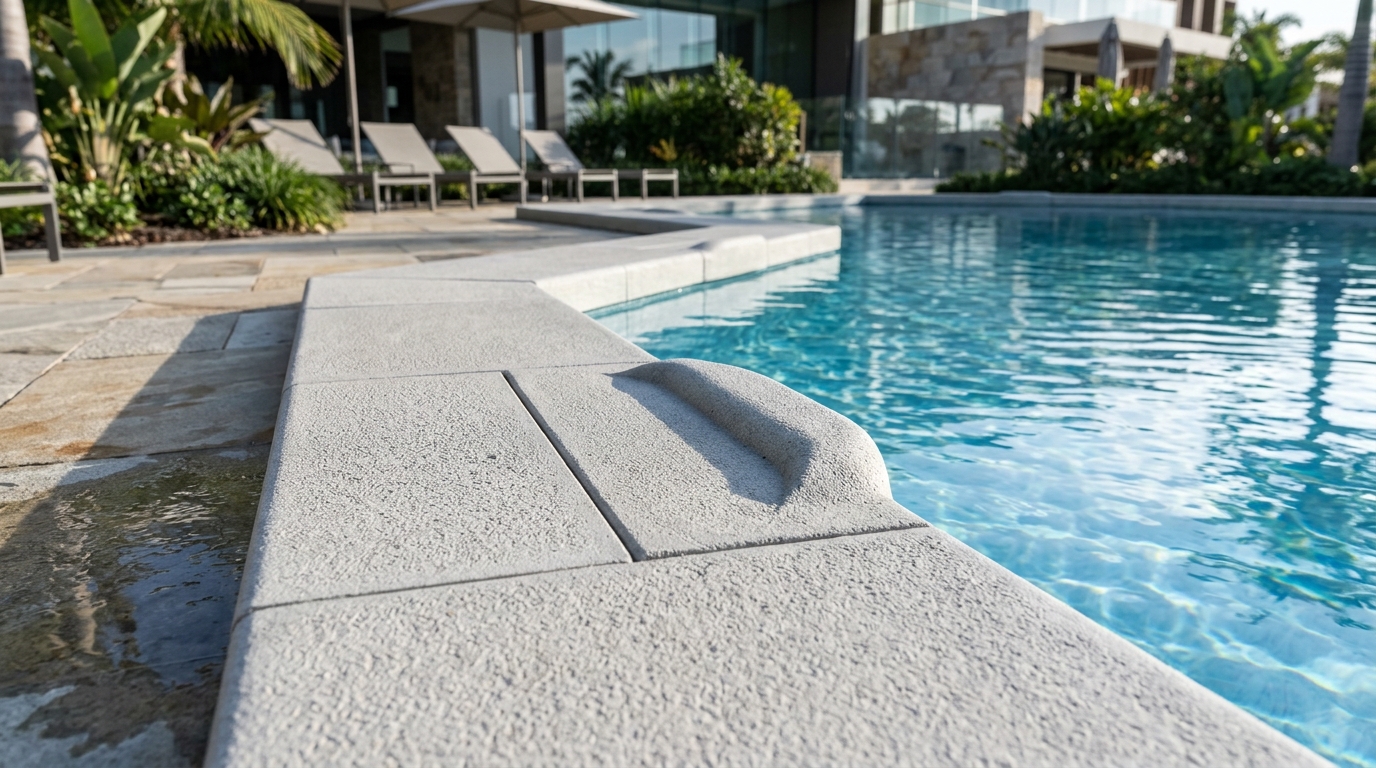
Commercial swimming pool facilities, municipal aquatics centers, and luxury hospitality venues require specialized pool surround materials that prioritize public safety without compromising structural longevity. Non-slip precast pool edge copings provide an engineered solution by integrating anti-slip surface textures, ergonomic grab profiles, and high-density concrete formulations directly into pre-manufactured structural units. Designed to meet demanding architectural standards, these precast elements resist chemical degradation from chlorine and saltwater, withstand severe freeze-thaw cycles, and reduce maintenance overhead across extended operational lifespans.
Technical Criteria for High-Performance Precast Pool Copings
Specifying pool surround elements for high-traffic environments requires a thorough evaluation of material behavior under continuous water exposure. Standard paving tiles often lack the surface micro-texture required to maintain traction when submerged or wet. Custom-engineered architectural precast elements are manufactured under controlled factory conditions, allowing precise control over aggregate distribution, water-cement ratios, and surface finishing.
When reviewing product parameters for commercial installations, project planners must analyze several critical performance metrics:
- Slip Resistance Ratings: Surface textures must achieve high non-slip classification (typically R11 to R13 standard equivalent) under wet-barefoot conditions to prevent hydroplaning and slips.
- Water Absorption Rate: Low porosity is essential to prevent moisture absorption, which causes internal cracking during freezing temperatures. Quality precast mixes maintain water absorption rates below 3%.
- Flexural and Compressive Strength: Pool copings must support static weight and dynamic perimeter loads without micro-fracturing along the deck edge.
- Chemical Resistance: Materials must withstand continuous exposure to pool balance chemicals, including chlorine, bromine, ozone, and salt-chlorination systems.
For detailed engineering metrics and testing benchmarks, refer to our comprehensive technical specification data sheet.
Ergonomics and Edge Profiles: Balancing Safety and Facility Design
The transition between the pool basin and the wet deck represents the highest-risk zone in any aquatic center. A specialized non-slip precast pool edge grab tile features a molded handhold profile—often termed a safety grip edge—that allows swimmers to securely hold the perimeter. Unlike flat natural stone borders, precast concrete can be cast with consistent finger-recess channels and radiused bullnose edges that fit human ergonomics.
Integrated drip grooves on the underside of precast units also stop splash-out water from migrating deep under the deck paving, preventing sub-base erosion and premature sealant failure. By selecting specialized precast coping systems, architects unify perimeter drainage, hand-grab functionality, and deck edging into a single monolithic installation.
Architectural Advantages of Precast Concrete Over Alternative Materials
While natural stone and vitrified ceramic tiles are common pool surround materials, precast concrete provides distinct advantages in commercial and municipal developments:
- Dimensional Consistency: Precast units feature minimal dimensional variance, ensuring uniform joint lines, aligned grab profiles, and faster site assembly.
- Custom Mold Flexibility: Complex radius curves, custom depth steps, and integrated drainage slots can be pre-cast offsite, eliminating labor-intensive field cutting.
- Color and Texture Homogeneity: Through-body pigmentation ensures that long-term surface abrasion does not reveal contrasting underlying layers, preserving visual appeal.
- Thermal Comfort: Optimized precast aggregate mixes retain less radiant surface heat than dark natural stones, keeping pool perimeters comfortable for barefoot traffic.
Installation Protocols for Long-Term Structural Integrity
Achieving a durable pool coping installation depends heavily on sub-base preparation, mortar bed selection, and expansion joint detailing. Because pool walls experience minor structural movements due to hydrostatic pressure and thermal expansion, coping units must be installed on a fully cured concrete bond beam using polymer-modified flexible adhesives.
Continuous expansion joints must be maintained between the precast coping unit and the surrounding deck slab. Filling these joints with high-performance elastomeric sealants prevents mechanical stress transfer, protecting both the pool shell and the coping edge from shear cracking.
Frequently Asked Questions Regarding Precast Pool Edge Solutions
How does a non-slip precast pool edge handle maintain its grip over time?
Unlike topical anti-slip coatings that wear off under foot traffic, precast units feature structural micro-textures created during the molding and aggregate-exposure process. This keeps the slip-resistant texture effective throughout the product's entire operational lifespan.
Can precast pool coping withstand saltwater chlorination systems?
Yes. High-density precast concrete manufactured with low water-cement ratios and specialized pozzolanic additives exhibits superior resistance to salt crystallization and chemical attack compared to porous natural stone.
Are custom radius pieces available for irregular pool shapes?
Precast manufacturing allows for custom mold creation tailored precisely to architectural drawings, ensuring exact match radii for curved pool perimeters, internal steps, and spa edges.
Selecting the Ideal Precast Specification for Your Next Project
Choosing the right perimeter coping system is critical to creating safe, low-maintenance aquatic facilities. Topaz Precast manufactures specialized concrete elements designed to withstand harsh outdoor conditions, heavy foot traffic, and aggressive pool chemistry. To discuss custom mold options, request material samples, or obtain project estimates, contact our engineering team directly via our project consultation page.