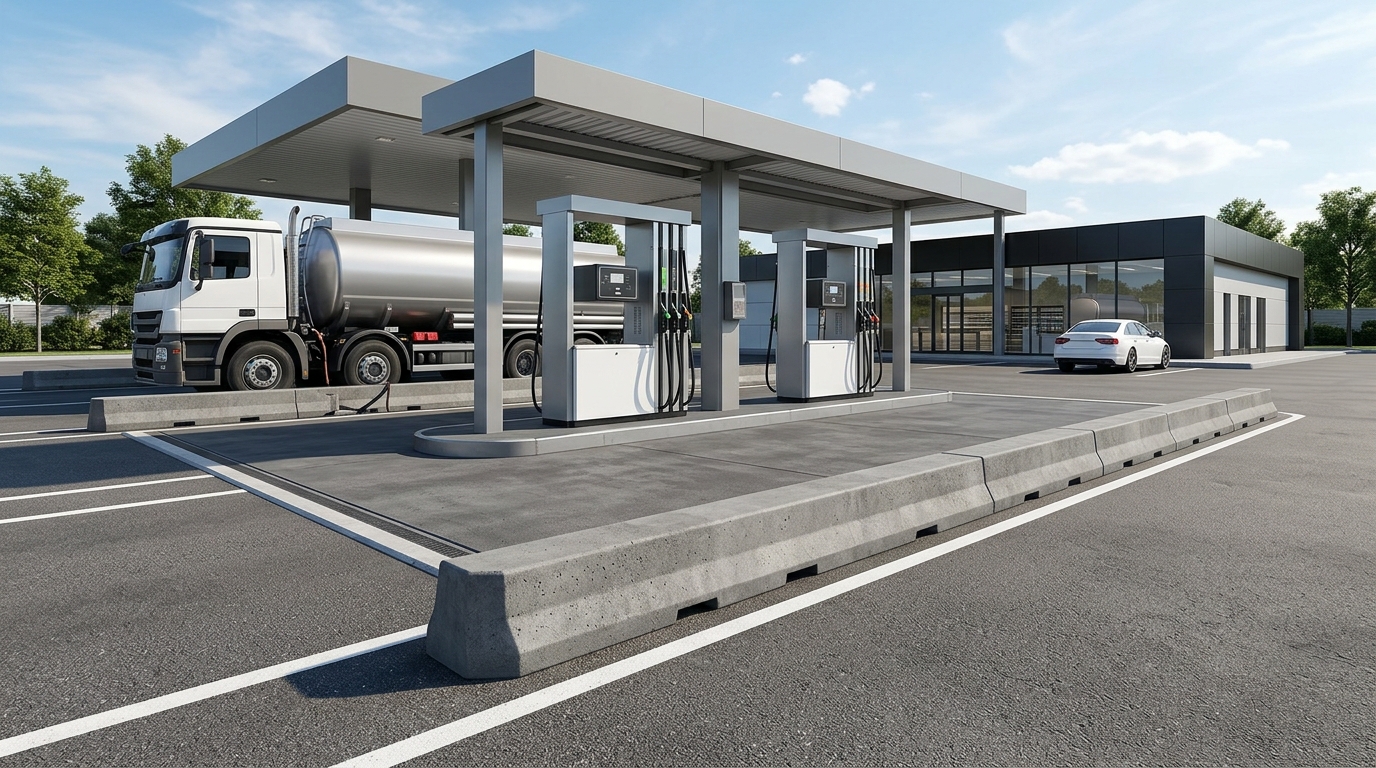
Fuel station forecourts operate under extreme mechanical and environmental conditions. Constant heavy-vehicle maneuvers, fuel and chemical exposure, thermal fluctuations, and continuous point loads demand specialized site infrastructure. Standard cast-in-place concrete or basic municipal edging frequently fails under these stresses, leading to cracking, spalling, and costly forecourt downtime. Utilizing high-density precast fuel station concrete curb solutions ensures structural perimeter containment, protects fuel dispenser pumps, and maintains clean visual alignment across high-traffic service areas.
Structural Demands on Fuel Station Forecourt Infrastructure
Forecourt perimeter barriers and island curbs serve a critical dual purpose: protecting underground infrastructure and guiding traffic safely away from hazardous pump zones. Standard curbing materials lack the density and chemical resistance needed to endure daily operations at commercial refueling facilities.
- Impact Resistance: Heavy supply trucks, fuel tankers, and commercial fleets frequently brush against curb edges. High-strength precast concrete prevents structural fracturing upon vehicle contact.
- Chemical Resistance: Hydrocarbon spills, petroleum runoff, and de-icing chemicals deteriorate low-grade concrete mixes. Precast elements produced under controlled curing conditions offer minimal absorption rates.
- Dimensional Precision: Modular precast units enable tight joint seals, preventing hazardous liquids from seeping beneath the pavement into subgrade layers.
Core Precast Concrete Components for Station Layouts
Modern forecourt design relies on specialized modular components configured to match specific site geometry, pump layouts, and pedestrian walkways.
Straight and Curved Edging Solutions
Defining driveways, boundary lines, and perimeter landscaping requires consistent linear profiles. High-density straight curbs form long, resilient borders capable of holding asphalt and concrete pavement edges intact. For tight turns, turning radiuses, and island headers, precision-molded curved curbs eliminate hand-casting flaws on-site and maintain uniform aesthetic height.
Integrated Station Sets and Pump Islands
Protecting fuel dispensers requires robust elevated barriers. Pre-engineered gas station sets provide ready-to-install island protection systems that integrate seamless radius ends with durable side profiles. These factory-cured assemblies drastically reduce installation timelines compared to traditional formwork, ensuring rapid station commissioning or refurbishments.
Future-Proofing Forecourts with Electric Vehicle Charging Islands
As service stations transition into multi-energy hubs, integrating fast-charging EV zones alongside conventional fuel pumps presents new layout requirements. Electrical conduits, high-voltage equipment, and delicate charging posts demand enhanced physical protection from accidental vehicular impact.
Standard curb layouts often lack the internal channels or cable entry points needed for fast chargers. Purpose-built EV charging station islands solve this challenge by offering pre-formed conduit access, elevated bumper protection, and clean modular expansion capabilities tailored for modern EV infrastructure.
Key Material Standards for Precast Forecourt Curbs
When specifying precast concrete for heavy commercial use, civil engineers and facility managers should evaluate material parameters against strict load-bearing standards:
| Property | Standard Specification | Forecourt Operational Benefit |
|---|---|---|
| Compressive Strength | C40/50 Concrete Grade or Higher | Prevents crushing under heavy axle loads and tanker impacts. |
| Water Absorption Rate | Below 5% | Resists freeze-thaw cracking and chemical fluid ingress. |
| Abrasion Resistance | Class 4 / High Density Aggregate | Maintains structural surface integrity against heavy tire wear. |
| Dimensional Tolerance | ±2 mm factory precision | Ensures uniform joints, easy sealing, and rapid field assembly. |
Engineers can review full performance metrics across product lines by checking our technical specifications table prior to site design finalized approval.
Frequently Asked Questions
Why are precast concrete curbs preferred over poured-in-place concrete at fuel stations?
Precast curbs are manufactured in controlled factory environments, achieving significantly higher density, uniform compressive strength, and lower permeability. Poured-in-place concrete on job sites is susceptible to rain, temperature shifts, improper mixing, and extended curing delays that disrupt station construction schedules.
How do precast island curbing systems protect underground utilities?
Precast curb profiles anchor securely into the sub-base, absorbing and distributing kinetic impact energy across the perimeter block rather than transferring localized sheer force down into underlying pipework, fuel conduits, or electrical cabling.
Can precast station curbs be customized for specific canopy or pump configurations?
Yes. Precast units are produced in modular kits comprising straight lengths, specialized corner pieces, and radial ends, allowing tailored layouts for single, double, or multi-dispenser island arrangements.
Selecting the Right Precast Solutions for Forecourt Projects
Designing a resilient, low-maintenance forecourt requires matching concrete specifications with anticipated traffic volume, heavy vehicle turning radiuses, and chemical exposure levels. Incorporating modular precast curb assemblies minimizes long-term maintenance costs, mitigates fuel spillage risks, and ensures perimeter protection for critical station infrastructure.
For custom engineering guidance, project-specific drawings, or direct procurement inquiries for fuel station infrastructure projects, please contact the engineering team through our contact page to discuss your forecourt development needs.