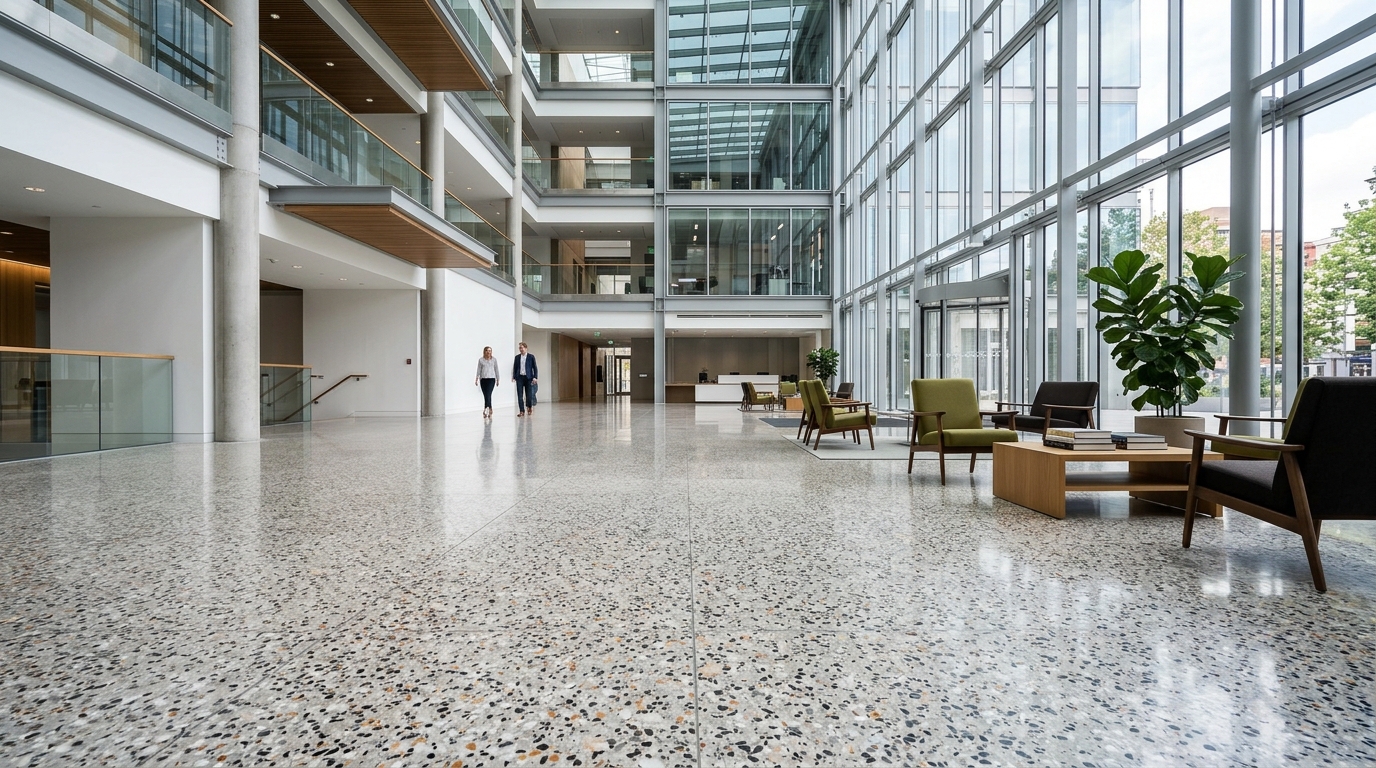
Sustainable terrazzo indoor flooring has emerged as the premier surface solution for corporate headquarters, public institutions, and high-traffic commercial spaces. By blending recycled marble, granite, and quartz aggregates with high-performance binding agents, precast terrazzo offers exceptional structural integrity alongside a minimal environmental footprint. Corporate decision-makers and architects increasingly specify terrazzo not only for its refined aesthetic versatility, but also for its lifecycle efficiency, easy maintenance, and alignment with modern green building standards.
Environmental Footprint and Circular Material Advantage
The sustainability of terrazzo indoor flooring stems from its circular material model. Rather than relying entirely on virgin quarried stone, precast terrazzo tiles integrate post-industrial marble and stone fragments that would otherwise end up as byproduct waste. This resource efficiency significantly reduces raw material extraction demands.
- Recycled Content Integration: Up to 70% of the aggregate volume in modern precast terrazzo can consist of reclaimed stone chips and quartz.
- Low Volatile Organic Compounds (VOCs): Factory-cured precast terrazzo tiles eliminate major off-gassing issues during installation, maintaining healthy indoor air quality (IAQ).
- Thermal Mass Efficiency: Terrazzo absorbs and retains ambient indoor temperatures, contributing to optimized HVAC load management in large corporate atriums and lobbies.
Key Technical Specifications for Commercial Indoor Applications
When selecting indoor flooring for high-foot-traffic corporate facilities, technical compliance is critical. Precast terrazzo engineered under controlled factory conditions delivers uniform compressive strength, minimal water absorption, and consistent dimensional tolerance across every module. Architects can explore detailed performance parameters on our dedicated technical specification table to match load requirements.
Standard specifications for commercial indoor terrazzo include:
- Compressive Strength: Typically exceeding 60 to 75 MPa, ensuring resistance against heavy rolling loads and structural impacts.
- Water Absorption Rate: Maintained below 2-3%, preventing deep staining from chemical spills or routine moisture exposure.
- Abrasion Resistance: High resistance to surface wear under continuous daily foot traffic.
- Dimensional Consistency: Factory-calibrated thickness ensures level installation across large floor spans when specifying our interior terrazzo tiles.
Installation Best Practices: Grout Joint Spacing and Surface Levelness
Achieving a seamless finish with sustainable terrazzo indoor flooring depends heavily on precise substrate preparation and correct installation protocols. For 20x20 cm, 30x30 cm, or larger modular precast tiles, careful attention must be given to joint spacing and leveling to prevent lip page and stress cracking.
- Substrate Levelness: The underlying concrete slab must be cured, clean, and level within 3 mm over a 3-meter straight edge.
- Grout Joint Width: A standard joint gap of 2 mm to 3 mm is recommended to accommodate minor thermal expansion while maintaining a continuous visual field.
- Grout Selection & Sealing: Using flexible, polymer-modified grouts matching the base binder color enhances spatial continuity. Detailed step-by-step guidance is available in our resource on interior polished surface application and grout recommendations.
Long-Term Maintenance and Lifecycle Cost Efficiency
While the initial investment in precast terrazzo may be higher than lower-tier vinyl or standard ceramic options, its total cost of ownership (TCO) over a 30-to-50-year building lifecycle is substantially lower. Terrazzo does not require frequent replacement or aggressive chemical stripping.
Daily maintenance relies on simple dry dust mopping and damp mopping with neutral pH cleaning solutions. Periodic re-sealing with water-based penetrating sealers protects the matrix from stain penetration without introducing harsh solvent fumes into the working environment. Should surface dulness occur after decades of heavy traffic, terrazzo can be re-polished in situ to restore its original luster without structural replacement.
Frequently Asked Questions About Indoor Terrazzo Flooring
How does terrazzo flooring contribute to LEED certification?
Terrazzo contributes to LEED points under Material & Resources (reclaimed stone content, regional manufacturing) and Indoor Environmental Quality (low VOC emissions and non-toxic binder systems).
What is the typical lifespan of precast terrazzo tiles in commercial spaces?
Precast terrazzo flooring is designed to match the structural lifespan of the building, routinely exceeding 40 to 50 years with minimal routine maintenance.
Are precast terrazzo tiles slip-resistant for indoor public areas?
Yes. By applying specialized honed or micro-textured surface finishes and anti-slip penetrating sealers, terrazzo floors meet international dynamic coefficient of friction (DCOF) standards for commercial pedestrian traffic.
Selecting the Right Precast Terrazzo Specification for Your Project
Specifying sustainable terrazzo indoor flooring requires aligning aesthetic design goals with rigorous engineering standards. From customized aggregate color blends to customized tile dimensions, precast manufacturing ensures exact quality control across all project phases. To review customized color options, structural test reports, or consult on technical specifications for your upcoming commercial project, please reach out directly through our contact page.