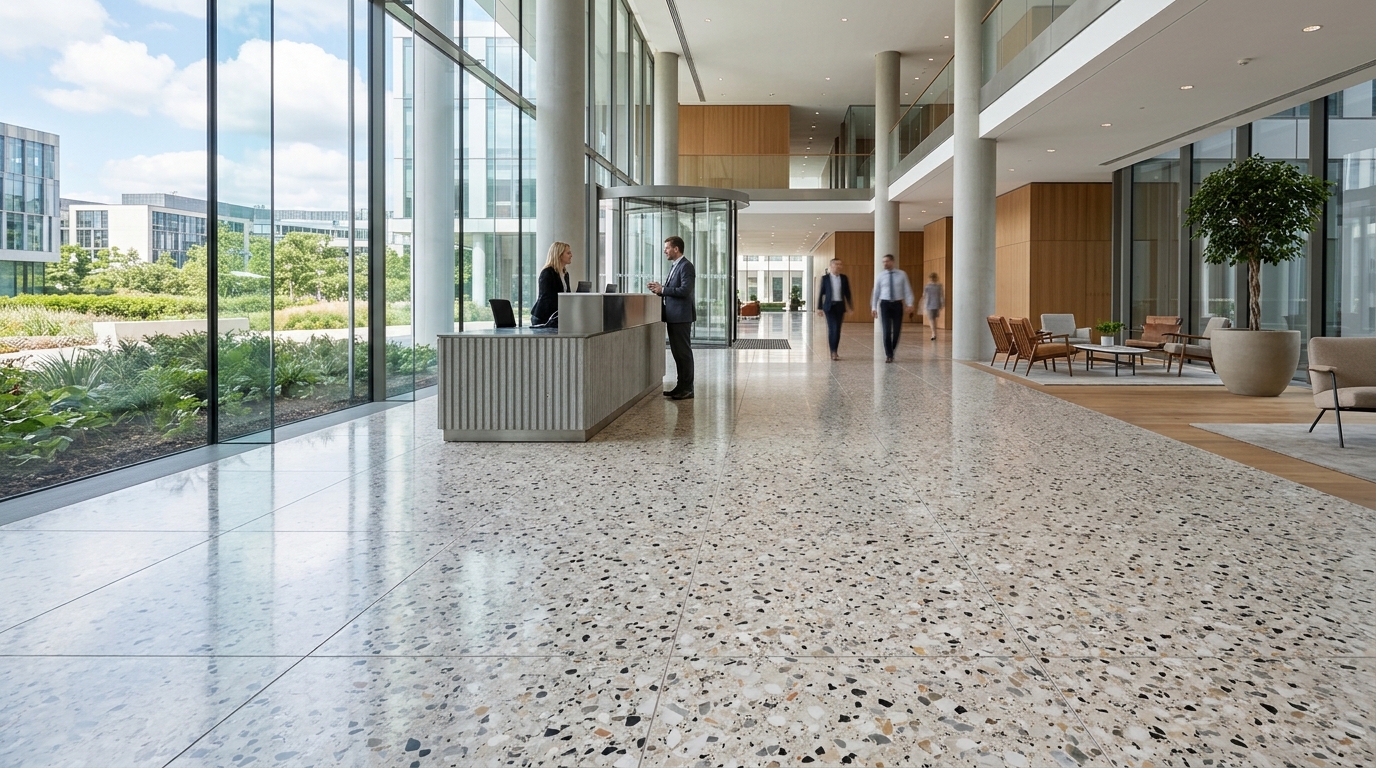
Single-layer terrazzo tiles—often referred to as monolayer terrazzo—are high-performance architectural surfacing materials produced by pressing a single, homogeneous mixture of marble or stone aggregates, high-strength cement, and specialized additives under intense vacuum pressure. Unlike traditional dual-layer tiles that feature a coarse backing layer beneath a decorative face layer, single-layer terrazzo offers uniform material composition throughout its entire thickness. This single-matrix structure delivers exceptional flexural strength, reduced weight per square meter, low moisture absorption, and outstanding resistance to heavy foot traffic, making it an optimal surfacing choice for modern commercial, institutional, and urban infrastructure projects. To evaluate comprehensive material benchmarks, architects frequently consult our technical specifications table.
Key Technical Characteristics of Single-Layer Terrazzo Tiles
Engineering advances in vacuum compaction and hydraulic pressing have elevated single-layer terrazzo beyond standard floor coverings. By removing excess water and air pockets during production, manufacturers achieve a dense micro-structure that performs reliably under intense environmental and mechanical stress.
- Homogeneous Thickness: Because the material matrix is consistent from top to bottom, the tile maintains identical physical properties across its entire profile, ensuring uniform wear over decades.
- Reduced Structural Dead Load: Single-layer tiles can be manufactured at thinner profiles—typically 15 mm to 20 mm—without compromising mechanical strength. This significantly reduces building load compared to conventional 30 mm dual-layer tiles.
- Low Water Absorption: The dense compaction process yields micro-porosity levels well below standard concrete tiles, protecting the surface against freeze-thaw spalling, staining, and chemical degradation.
- High Abrasion and Impact Resistance: Formulated with hard marble, granite, or quartz aggregates, monolayer tiles exhibit superior deep-abrasion resistance suited for heavy-traffic zones.
- Dimensional Precision: Modern recalibration and factory-honing processes provide tight dimensional tolerances, allowing for narrow joint installations and seamless spatial aesthetics.
Single-Layer vs. Dual-Layer Terrazzo: Structural & Operational Comparison
Choosing between single-layer and traditional dual-layer terrazzo involves evaluating structural constraints, installation methods, and long-term performance requirements. The table below outlines key technical differences:
| Property / Parameter | Single-Layer Terrazzo Tiles | Traditional Dual-Layer Terrazzo |
|---|---|---|
| Composition | Homogeneous single-density mixture | Face layer + coarse backing layer |
| Typical Thickness | 15 mm – 22 mm | 30 mm – 40 mm |
| Weight Load | Significantly lower (~35-45 kg/m²) | Higher (~70-90 kg/m²) |
| Flexural Strength | High (uniform tension distribution) | Moderate (risk of delamination at interface) |
| Subfloor Compatibility | Ideal for retrofits and elevated slabs | Requires substantial slab depth and load margin |
High-Traffic Commercial and Public Application Areas
The structural attributes of single-layer terrazzo make it uniquely suited for high-density public spaces where physical durability, cleanability, and aesthetic longevity must co-exist seamlessly.
1. Transit Hubs and Transportation Terminals
Airports, metro stations, and train concourses experience continuous pedestrian traffic, rolling luggage loads, and heavy maintenance machinery. Single-layer terrazzo provides a slip-resistant, wear-resistant surface capable of retaining its structural integrity without cracking or surface erosion.
2. Retail Malls and Commercial Centers
Large-scale retail spaces demand flooring that withstands constant footfall while maintaining sophisticated visual appeal. Monolayer tiles support custom aggregate combinations and colors, creating expansive, high-end floor plans. For complementary staircases and perimeter elements, specifiers frequently incorporate bespoke precast terrazzo elements to achieve design continuity.
3. Educational Institutions and Healthcare Facilities
In schools, universities, and hospitals, hygiene and low lifecycle maintenance are critical. Monolayer terrazzo offers non-porous surface treatments, resisting bacterial accumulation, harsh chemical cleaners, and frequent sanitization protocols.
4. Exterior Plazas and Covered Walkways
When specified with shot-blasted or textured surface finishes, single-layer terrazzo excels in exterior applications such as civic plazas, building entrances, and outdoor arcades, effectively managing slip risks under wet conditions.
Performance Parameters: Slip Resistance, Abrasion, and Thermal Behavior
When specifying outdoor or high-footfall indoor surfacing, design teams must evaluate verified performance values. Detailed testing reports and certifications can be accessed through our technical documentation archive.
- Slip Resistance (R-Values): Polished indoor surfaces typically achieve R9 to R10 ratings, whereas brushed or shot-blasted exterior tiles reach R11 to R13, preventing accidents in wet environments.
- Freeze-Thaw Resistance: With low water absorption, monolayer tiles resist internal hydraulic pressure caused by freezing moisture, preventing surface micro-cracking in cold climates.
- Thermal Stability: Single-layer terrazzo maintains thermal expansion coefficients compatible with standard screeds, making it compatible with radiant underfloor heating systems.
Installation and Jointing Guidelines for Long-Term Durability
Achieving a flawless terrazzo installation requires adhering to strict structural preparation and joint layout standards:
- Subfloor Preparation: The underlying concrete slab must be cured, fully stable, level, and free of dust, oils, or structural cracks.
- Adhesive Application: Use high-performance polymer-modified cementitious adhesives designed for low-absorption natural stone or precast tiles. Apply using the full-bed buttering technique to avoid voids.
- Joint Spacing: Maintain a minimum 2 mm to 3 mm grout joint. Never butt-joint terrazzo tiles, as structural expansion and minor thermal movements require elastic joint buffers.
- Movement Joints: Align floor expansion joints directly over structural control joints in the substrate, establishing perimeter expansion gaps along walls and columns.
Frequently Asked Questions
How does single-layer terrazzo reduce structural dead load?
Because single-layer tiles eliminate the thick cementitious backing layer found in dual-layer tiles, they achieve equal or higher flexural strength at half the thickness (15–20 mm vs 30–40 mm). This saves up to 40% in structural weight per square meter.
Can single-layer terrazzo tiles be re-polished in the future?
Yes. Because monolayer terrazzo consists of a homogeneous aggregate composition throughout its full depth, the surface can be ground and re-polished decades after installation without revealing a different backing layer.
Are single-layer terrazzo tiles suitable for exterior frost conditions?
When manufactured under vacuum compaction with low water absorption metrics and specified with appropriate non-slip finishes (such as shot-blasted or bush-hammered surfaces), single-layer terrazzo performs exceptionally well in frost-prone climates.
Specifying Single-Layer Terrazzo for Your Project
Selecting the correct tile specification involves evaluating foot traffic density, structural load limits, aesthetic aggregate choices, and slip resistance requirements. Integrating high-performance precast elements and single-layer terrazzo ensures your commercial space achieves both aesthetic distinction and decades of maintenance-free performance.
For custom aggregate designs, project-specific technical evaluations, or mock-up requests, connect directly with our engineering team through our contact and technical support page.