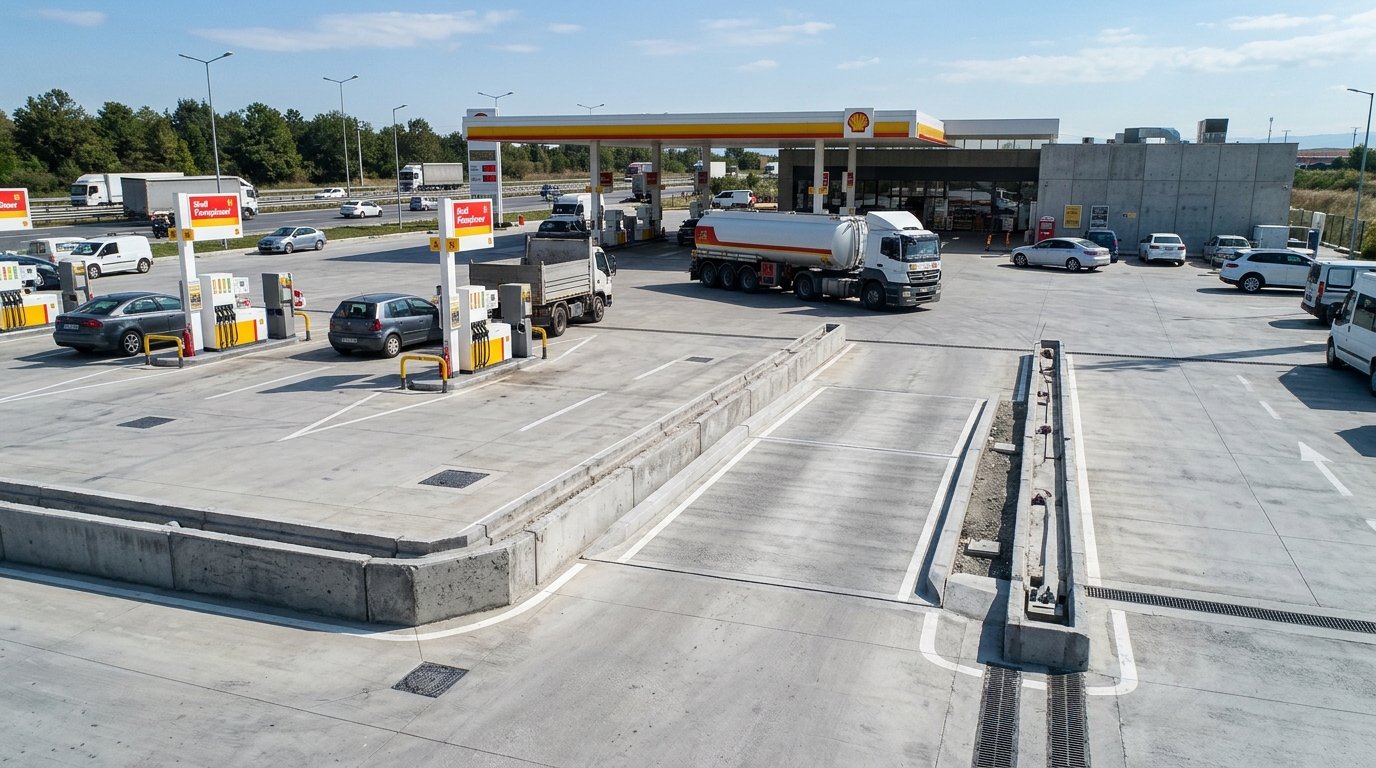
Commercial fuel station forecourts demand specialized civil engineering components capable of withstanding constant heavy vehicle traffic, severe point loads, and aggressive chemical exposure. Industrial gas station concrete kerb and ramp production focuses on manufacturing high-performance precast elements engineered specifically to safeguard pump islands, guide traffic flow, and ensure long-term structural resilience. By replacing traditional site-poured concrete with factory-cast modular units, site developers gain superior compressive strength, precise geometric accuracy, and immediate operational readiness.
Structural Requirements in Gas Station Forecourt Design
Fuel stations operate under harsh physical and chemical conditions. Curbs and access ramps around pump islands serve as the primary defensive barrier against vehicle collisions, protecting underground fuel lines, electrical conduits, and expensive dispensing equipment.
- Axle Load Capacity: Forecourt surfaces must support heavy commercial trucks, fuel delivery tankers, and buses. Precast kerbs and ramp modules are engineered with reinforced concrete formulations designed to resist lateral impact and high static loading without cracking or shifting.
- Chemical Resistance: Hydrocarbon fuels, motor oils, auto fluids, and chemical deicers rapidly degrade standard concrete mixes. Industrial precast manufacturing utilizes specialized low-permeability concrete mixes combined with hydrophobic additives to prevent chemical penetration and internal matrix breakdown.
- Impact Safety Geometry: Beveled profiles, bullnose edges, and specific curb angles divert vehicle tires safely away from pump islands, reducing the severity of wheel impact while preventing vehicle undercarriage damage.
- Weather Resilience: Freeze-thaw cycles present a major hazard for exterior concrete structures. Controlled curing environment and air-entrainment technology ensure high resistance to scaling and micro-fracturing across temperature extremes.
Precast Modular Components vs. Site-Poured Concrete
In traditional fuel station construction, kerbs and ramps were poured directly on-site using formwork. However, site-cast concrete frequently suffers from inconsistent moisture levels, inadequate vibration, long curing delays, and high labor overhead. Precast manufacturing eliminates these vulnerabilities by casting elements in controlled factory environments.
| Performance Factor | Precast Factory Production | Traditional Site-Poured Concrete |
|---|---|---|
| Quality Control | Strict material grading, automated batching, constant curing conditions | Variable weather impact, manual mixing inconsistencies |
| Installation Speed | Rapid modular placement; operational in hours | Requires multi-day setting, curing, and form removal |
| Dimensional Accuracy | Sub-millimeter mold precision for uniform island layout | Prone to warping, form deflection, and uneven edges |
| Surface Durability | High-density concrete matrix with smooth, low-porosity finish | Higher porosity, susceptible to surface spalling and oil stain absorption |
Key Precast Elements for Complete Station Islands
A resilient forecourt layout depends on a fully integrated suite of precast elements designed to lock together seamlessly. Specifying factory-engineered gas station precast sets ensures uniform alignment, seamless jointing, and comprehensive protection across the entire dispenser island footprint.
Linear Island Enclosures
Standard border management relies on robust straight kerbs designed to outline long island runs, walkway separations, and perimeter traffic dividers. These linear sections provide stable anchorage for island slabs and canopy structural posts.
Corner Protection and Radius Management
Island ends are particularly vulnerable to tight-turning vehicles. High-density curved kerbs create smooth radial transitions at island caps, absorbing lateral tire pressure and maintaining forecourt geometry without sharp corners that cause tire scuffing.
Access and Maintenance Ramps
Transition zones between forecourt pavement and elevated islands or service bays require specialized heavy-duty ramp sets. These components allow easy equipment access, wheelchair accessibility where required, and safe vehicle movement across level changes without chipping edge borders.
E-Mobility Infrastructure Integration
Modern service stations increasingly adopt hybrid fueling models. Precast production standards have evolved to incorporate dedicated EV charging station islands featuring built-in cable conduits, mounting anchor points, and elevated protective borders tailored for high-voltage fast chargers.
Manufacturing Specifications and Quality Standards
Achieving maximum longevity requires strict manufacturing parameters. Precast kerbs and ramp components intended for fuel station applications typically feature:
- High Compressive Strength: Formulated using C35/45 or C40/50 grade concrete mixes with optimized water-cement ratios.
- Structural Reinforcement: Integrated steel rebar cages or high-tensile synthetic fiber mesh to eliminate brittle failure modes under impact.
- Surface Finish Options: Natural smooth gray, high-visibility pigmented finishes, or anti-slip textured top surfaces for safe pedestrian foot traffic around pumps.
- Chamfered Edge Profiles: Standardized top chamfers to prevent chipping and improve overall forecourt visual aesthetics.
Frequently Asked Questions
Why is precast concrete preferred over site-cast concrete for gas station islands?
Precast concrete is manufactured under strictly controlled laboratory conditions, delivering higher compressive strength, superior chemical resistance, exact dimensional uniformity, and significantly faster on-site installation with zero curing downtime.
How do precast kerbs protect fuel dispensers from vehicle impacts?
Engineered precast kerbs feature thick cross-sections, heavy mass, and optimized profile angles designed to deflect vehicle tires back into the lane while absorbing and distributing impact energy away from the fuel dispenser island base.
Can precast concrete kerbs and ramps be customized for specific station branding?
Yes. Custom molds, specialized aggregate blends, integral color pigments, and concrete sealants can be tailored to match specific corporate brand identities, island dimensions, and site topography.
Selecting the Ideal Precast Infrastructure for Your Station Project
Investing in precision-manufactured concrete kerbs and ramp modules is essential for minimizing long-term maintenance, preventing forecourt shutdowns, and protecting critical fuel infrastructure. Choosing factory-certified precast components guarantees compliance with heavy load requirements while accelerating site construction schedules. For technical product details, custom dimensioning, or project quotations, consult the engineering team at the Topaz Precast contact page.