
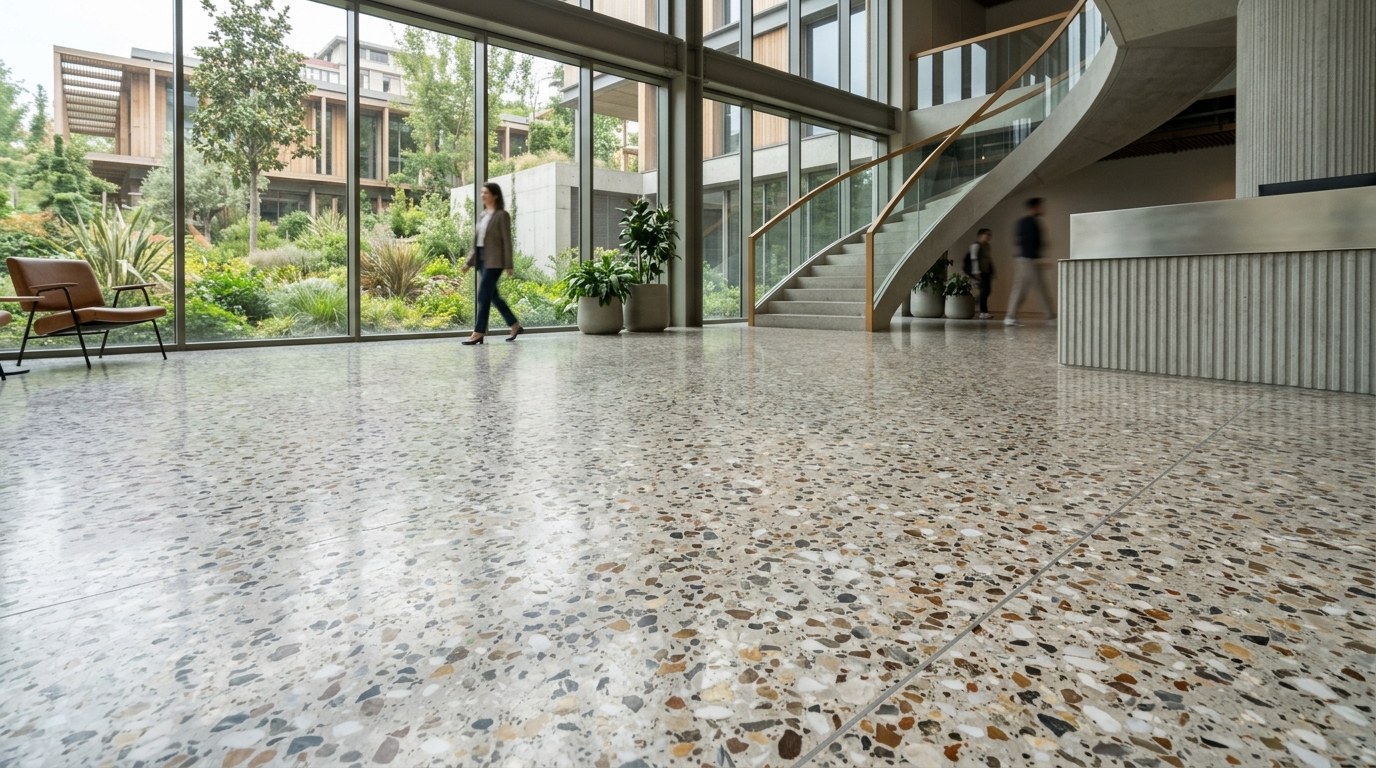
Sustainable terrazzo surface solutions provide architectural projects with high compressive strength, long operational lifespans, and low environmental impact. By utilizing recycled marble, granite, and glass chips bound within advanced cementitious matrices, engineered precast terrazzo surfaces eliminate the need for frequent material replacement. For commercial developers and green building planners aiming for LEED or BREEAM certifications, precast terrazzo delivers exceptional lifecycle performance, superior indoor air quality through zero-VOC emissions, and minimal maintenance demands across high-traffic environments.
Environmental Impact and Lifecycle Performance of Precast Terrazzo
Evaluating surface cladding materials requires looking beyond upfront material cost to assess total lifecycle environmental impact. Engineered terrazzo panels and tiles stand out in sustainable design due to their compositional efficiency and extreme longevity.
- Recycled Content Integration: Up to 70% of terrazzo aggregates consist of post-industrial recycled marble, quartzite, and natural stone fragments salvaged from quarrying waste.
- Zero VOC Emissions: Inorganic, cementitious precast terrazzo elements release zero volatile organic compounds, maintaining healthy indoor microclimates.
- Lifecycle Cost Efficiency: While initial installation requires precise engineering, a service life exceeding 40 to 50 years drastically reduces life-cycle carbon expenditure compared to short-lived synthetic coverings.
- Thermal Mass Optimization: High thermal density allows interior terrazzo floors to store and gradually release heat, contributing to passive thermal management in large-scale commercial facilities.
Technical Specifications for Indoor and Outdoor Commercial Applications
Performance requirements vary significantly depending on whether terrazzo is specified for internal modern public halls or external public plazas. Selecting the correct binder matrix, surface finish, and joint geometry determines long-term structural integrity.
Indoor Polished Applications
Interior commercial spaces prioritize high slip-resistance alongside low dirt retention and aesthetic clarity. Micro-honed and diamond-polished terrazzo surfaces require controlled joint spacing to absorb subtle building movements while preventing micro-cracking. Reviewing engineered indoor polished surface application and joint recommendations helps project managers select precise flexible grout formulations and expansion joint intervals suitable for heavy pedestrian traffic.
Outdoor Heavy-Duty Surfaces
Exterior applications face severe freeze-thaw cycles, solar exposure, and moisture loads. Precast exterior terrazzo tiles utilize shot-blasted or bush-hammered textures to achieve appropriate dynamic coefficient of friction (DCOF) values. Following structural outdoor surface application and joint recommendations ensures effective drainage slopes, capillary break layers, and weather-resistant elastomeric joint sealants prevent water ingress and sub-base degradation.
Key Material Characteristics: Durability, Load Capacity, and Thermal Resistance
Architects specify precast terrazzo when standard porcelain or poured-in-place materials fail to meet structural requirements. Pre-cured factory manufacturing ensures uniform density, precise aggregate distribution, and consistent flexural strength.
| Technical Parameter | Standard Precast Terrazzo Value | Performance Benefit |
|---|---|---|
| Compressive Strength | > 60 - 80 MPa | Resists extreme point loads and heavy equipment transport. |
| Water Absorption | < 2.0% to 3.5% | Prevents stain penetration and freeze-thaw spalling. |
| Abrasion Resistance | Class 1 / High Resistance | Maintains surface polish despite high foot traffic volume. |
| Fire Reaction Rating | A1 Non-combustible | Meets stringent life-safety requirements in public transport hubs. |
Detailed physical metrics, slip resistance ratings, and load tables are systematically documented within our technical specification table to support engineering compliance during project planning.
Integrating Precast Terrazzo Elements: Treads, Cladding, and Custom Forms
Modern architectural continuity relies on specified surface solutions extending effortlessly across vertical and horizontal planes. Precast manufacturing allows specialized elements to be cast off-site with absolute geometric precision.
- Monolithic Stair Treads and Risers: Custom-cast terrazzo steps ensure consistent anti-slip nosing details, high impact resistance along edges, and seamless integration with floor layouts.
- Architectural Wall Cladding: Thin-shell precast terrazzo panels provide durable interior and exterior rain-screen facades resistant to environmental pollutants and graffiti.
- Custom Structural Accents: Complex corner units, transition pieces, and integrated kerbs can be produced under controlled factory conditions, drastically reducing site labor and installation errors.
Specification Checklist for Sustainable Terrazzo Flooring Projects
Achieving optimal installation performance requires rigorous technical review prior to site delivery. Use this checklist during design development and procurement phases:
- Subfloor Preparation: Verify that concrete slabs are fully cured, level, free of laitance, and engineered to withstand total dead and live design loads.
- Aggregate Selection: Specify locally sourced aggregates where possible to minimize transportation emissions while achieving desired color palettes.
- Tile Thickness vs. Dimensions: Match panel dimensions to anticipated load profiles; larger formats (e.g., 60x60 cm or 40x80 cm) demand higher flexural strength and precise bed levelling.
- Joint Engineering: Ensure perimeter expansion joints match structural movement joints in the primary slab, using high-performance polyurethane or silicone fillers.
- Sealing & Maintenance Protocols: Require penetrating, water-based, non-film-forming sealers that preserve vapor permeability while repelling oil and water contaminants.
Frequently Asked Questions
How does precast terrazzo contribute to LEED certification?
Precast terrazzo contributes to LEED points under Materials and Resources (MR) credits through recycled aggregate content, regional material sourcing, and product longevity. Additionally, its zero-VOC composition supports Indoor Environmental Quality (EQ) low-emitting material standards.
What is the difference between epoxy terrazzo and cementitious precast terrazzo?
Epoxy terrazzo uses resin binders suitable mainly for thin interior floors, whereas cementitious precast terrazzo relies on hydrated cement matrices. Cementitious precast offers higher fire resistance, total UV stability for exterior applications, and superior compatibility with traditional stone restoration techniques.
Can damaged terrazzo surface coatings be restored without full replacement?
Yes. One of the strongest sustainability features of terrazzo is its renewability. Scratched or dull surfaces can be re-ground, diamond-polished, and re-sealed on-site, restoring the floor to its original finish without generating demolition waste.
Implementing Terrazzo Surface Solutions in Enterprise Projects
Selecting structural cladding and flooring solutions requires balancing architectural vision with long-term facility performance. Precast terrazzo provides commercial decision-makers with a proven material option that satisfies aggressive sustainability targets without sacrificing structural strength or design flexibility. To review custom mix designs, request physical samples, or receive project-specific engineering consultation, connect directly with our technical department via our contact and inquiry page.