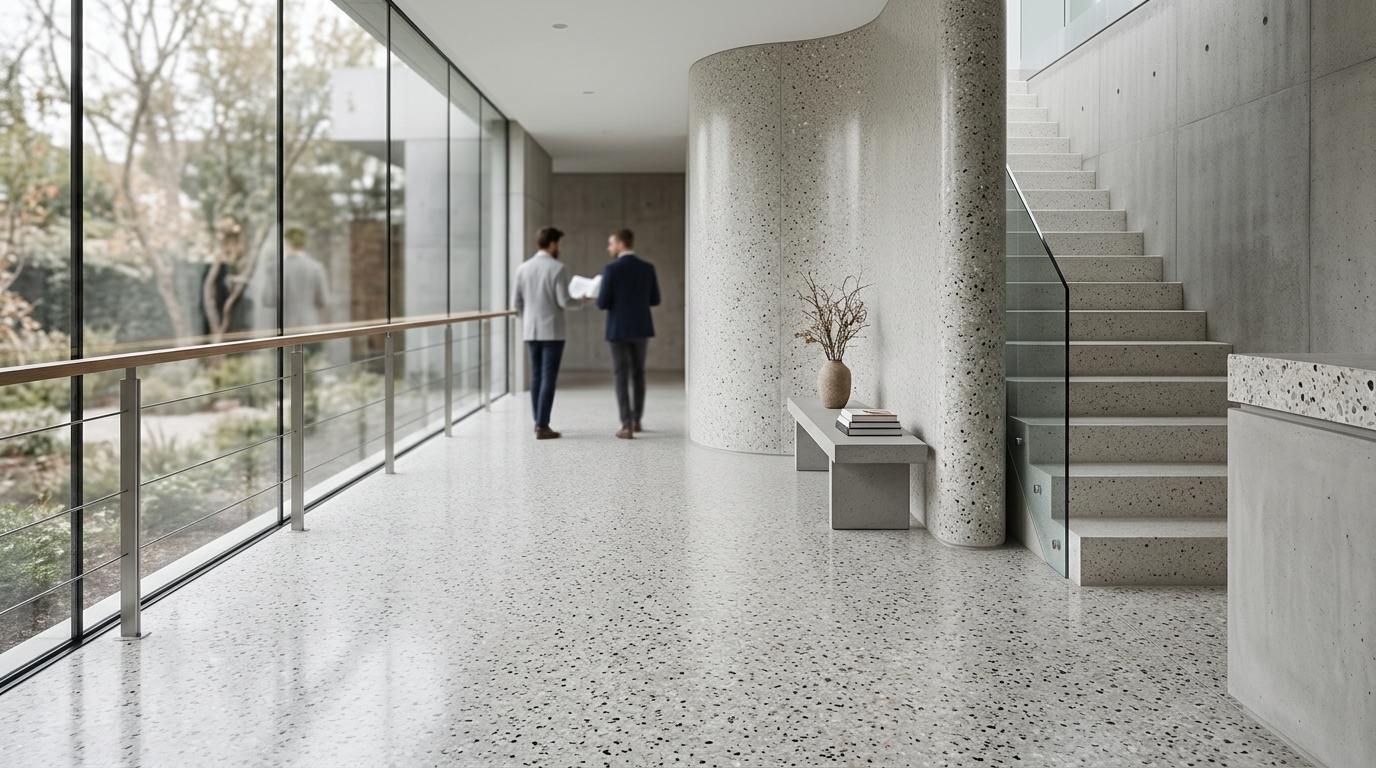
Specifying interior terrazzo surfaces for architectural projects provides structural resilience, low life-cycle maintenance, and high design adaptability. Modern commercial spaces—such as corporate headquarters, transport hubs, educational campuses, and luxury retail centers—demand surface materials capable of enduring heavy foot traffic without compromising visual integrity. Engineered precast terrazzo offers high flexural strength, custom matrix formulations, and precise thickness control, making it an ideal choice for large-scale interior applications. Exploring specialized interior precast terrazzo tiles allows architects and decision-makers to achieve seamless transitions across expansive floor plans while strictly adhering to structural load parameters.
Structural and Mechanical Performance in High-Traffic Interiors
Commercial interior floors undergo persistent compressive stress, point loads, and surface abrasion. Precast interior terrazzo tile assemblies overcome the micro-cracking and batch variations often associated with traditional poured-in-place installations. Factory-cured precast units undergo monitored hydration and compaction, yielding superior density and uniform flexural performance.
- Abrasion Resistance: High-density aggregate exposure resists surface wear under intense daily pedestrian traffic.
- Dimensional Stability: Factory calibration ensures uniform tile depth and clean edge profiles, simplifying joint alignment.
- Fire and Thermal Safety: Being an inorganic mineral composite, precast terrazzo is non-combustible and releases zero toxic fumes under extreme heat exposure.
- Subfloor Compatibility: Suitable for installation over concrete slabs, raised access systems, and integrated underfloor heating setups.
Architects and structural engineers can review detailed physical properties, compressive values, and slip-resistance metrics on our technical specifications sheet to verify compliance with national building codes and project-specific load criteria.
Customization: Aggregates, Matrices, and Visual Flexibility
Terrazzo derives its character from the deliberate combination of decorative aggregates and high-strength matrix binders. Designers can tailor the surface visual by manipulating aggregate size, mix ratios, and background pigments.
1. Aggregate Selection
Natural marble chippings, basalt, quartz, glass fragments, and recycled granite chips can be blended into precast matrices. Aggregate sizing ranges from fine micro-terrazzo grains to large-scale macro chunks that create bold graphical statements.
2. Matrix Formulations
Cementitious and resin-modified cement matrices allow precise color matching against Pantone or RAL standards. Color consistency across large production batches ensures uniform tonal continuity from main concourses to staircases and corridors.
Application Standards and Joint Grouting Best Practices
Achieving a flawless finished floor requires rigorous substrate preparation, correct adhesive selection, and precise joint sealing techniques. Improper movement joint placement or incorrect grout selection can lead to edge spalling or moisture entrapment beneath polished surfaces.
Key installation guidelines include:
- Substrate Moisture & Levelness: Concrete base slabs must be cured, dry, and leveled to prevent differential deflection.
- Movement Joints: Perimeter isolation joints and perimeter expansion control joints must mirror the building's structural expansion gaps.
- Grout and Sealer Selection: Use non-staining, flexible joint grouts and breathable impregnating sealers to protect against staining while allowing residual vapor drive.
For exhaustive technical steps on surface grinding, protective coatings, and joint fill selection, review our guide on interior polished surface application and joint grout recommendations.
Life-Cycle Assessment and Sustainability Metrics
For corporate decision-makers and sustainability managers, material selection is evaluated through long-term operational costs and environmental performance. Terrazzo surfaces stand out as long-life architectural solutions.
| Evaluation Metric | Precast Interior Terrazzo | Standard Flooring Alternatives |
|---|---|---|
| Expected Service Life | 50+ Years with minimal restoration | 10–15 Years before replacement |
| Maintenance Requirements | Neutral pH cleaning, periodic sealing | Frequent stripping, polishing, or recoating |
| VOC & Off-Gassing | Zero VOC emissions (cured inert mineral) | Varies; potential synthetic off-gassing |
| Recycled Content | Up to 40% recycled aggregate options | Limited recycled material integration |
Architectural Project Evaluation: Key Selection Criteria
When selecting precast interior terrazzo surfaces for large-scale developments, project managers should evaluate four key decision factors during the schematic design phase:
- Traffic Volume and Load Profile: Identify expected static and dynamic loads to specify optimal tile thickness and substrate adhesive class.
- Maintenance and Hygiene Requirements: In healthcare or food-service environments, specify sealed, non-porous surface treatments that resist chemical sanitizer degradation.
- Acoustic and Thermal Integration: Coordinate tile thickness and underlayment materials with acoustic insulation membranes to control impact sound transmission.
- Custom Precast Elements: Match floor surfaces with complementary precast steps, wall bases, and skirtings to maintain aesthetic unity across all levels.
Explore completed commercial installations on our architectural projects portfolio to see how custom terrazzo surfaces perform in active corporate environments. To discuss technical specs or request custom color samples for your upcoming project, get in touch with our team via our contact page.
Frequently Asked Questions About Interior Architectural Terrazzo
Are precast interior terrazzo tiles suitable for underfloor heating systems?
Yes. Precast terrazzo tiles feature favorable thermal conductivity, allowing heat to transfer efficiently from hydronic or electric radiant heating systems without causing dimensional warping or surface cracking, provided proper movement joints are installed.
How do precast terrazzo tiles compare to poured-in-place terrazzo?
Precast tiles offer strictly controlled factory quality, uniform thickness, reduced on-site installation time, and elimination of intense wet-grinding slurry on the project site. Poured-in-place systems are seamless over vast spans but require longer curing times and specialized field grinding labor.
What surface finishes are available for interior terrazzo applications?
Interior terrazzo surfaces can be finished in polished (high gloss), honed (matte/satin finish for higher slip resistance), or brushed textures depending on slip resistance ratings (R-values) and design preferences.