
Mechanical Fixing Techniques for Precast Coping in High-Rise Buildings
High-rise buildings are subjected to exponentially increasing wind speeds and dynamic forces during seismic events. Precast coping, which protects the parapet walls of these structures, is not just an aesthetic finish but a critical component for structural integrity. In this guide, we explore the mechanical fixing techniques required for precast coping installation resistant to wind loads and seismic movements in high-rise projects.
Understanding Wind Loads and Seismic Demands on Parapet Walls
At the rooflines of skyscrapers, wind creates a 'vortex' effect, applying significant suction forces to surfaces. Conventional bonding methods often fail under this continuous pressure and suction cycle. Furthermore, during seismic activity, the oscillation of the building can cause rigidly fixed coping stones to dislodge, posing a life-safety risk. Therefore, the installation strategy must balance flexibility and durability, using mechanical fixing as the primary support.
Advanced Mechanical Securing Methods for Precast Coping
Mechanical systems used to fix precast concrete elements ensure that loads are transferred directly to the structural reinforced concrete frame.
Stainless Steel L-Bracket Systems
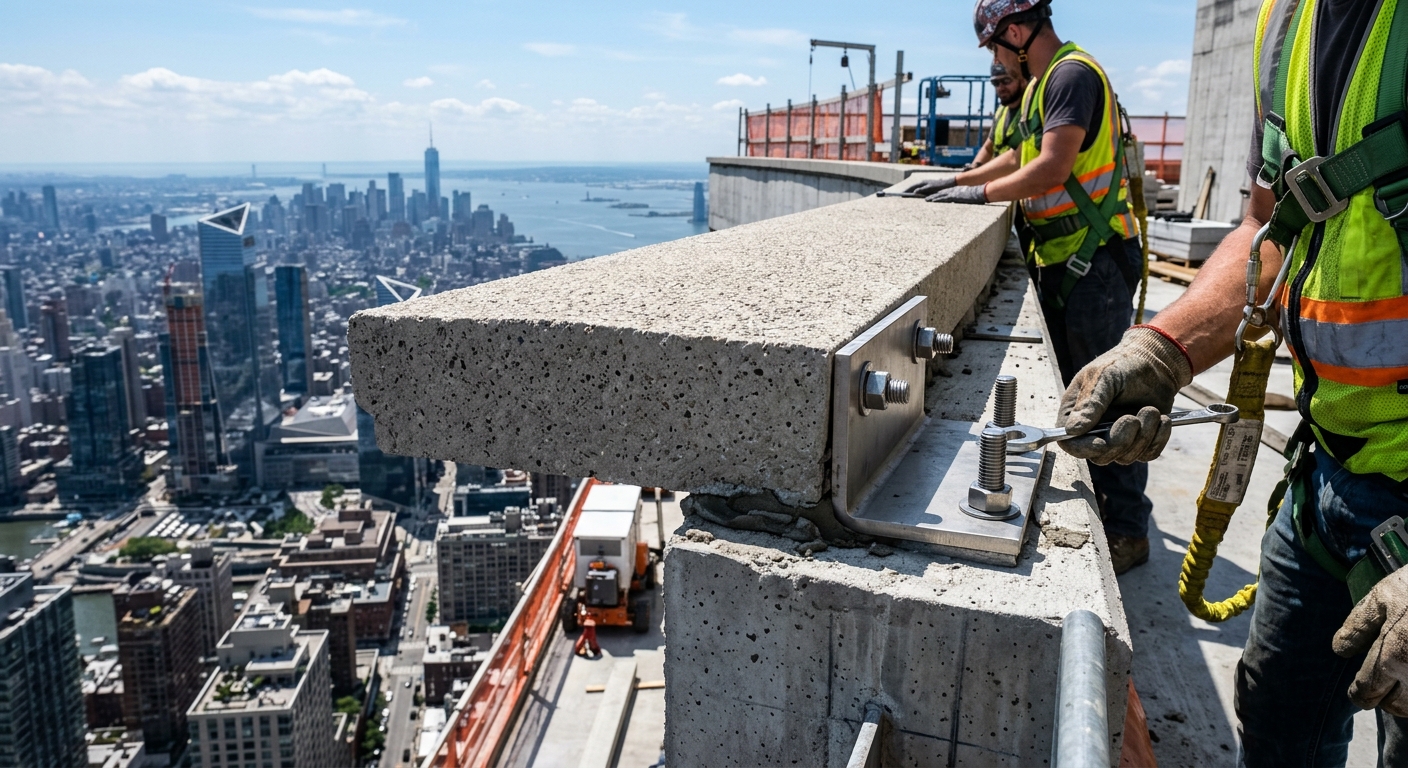
Stainless steel L-brackets inserted into pre-drilled slots at the bottom of the coping elements are among the most reliable fixing methods. Being corrosion-resistant, these brackets maintain their function throughout the building's lifespan. One end of the bracket is fixed to the precast element, while the other is secured to the parapet concrete using chemical anchors or expansion bolts.
Hidden Pinning and Rail Systems
In projects where visual aesthetics are paramount, 'hidden pinning' is preferred, allowing installation without visible holes on the coping surface. Stainless steel pins inserted into grooves at the bottom dampen the upward uplift forces caused by wind. For large-scale coping blocks, rail-mounted systems that allow for thermal expansion help reduce stress during seismic movements.
The Importance of Engineering Specs in High-Rise Facades
Coping installed only with mortar, without mechanical fixing, eventually shows signs of 'fatigue' in tall buildings. Cracks in the mortar lead to water ingress, which, through freeze-thaw cycles, can cause the element to detach completely. Anchorage depths that do not comply with wind speed calculations specified in engineering codes directly threaten structural safety.
In conclusion, the installation of precast coping in high-rise buildings should be treated as an engineering discipline rather than just an architectural detail. Utilizing correct mechanical fixing techniques ensures lower maintenance costs and a safe, aesthetic presence in the city skyline. It is critical to choose installation solutions that comply with technical specifications for your professional projects.