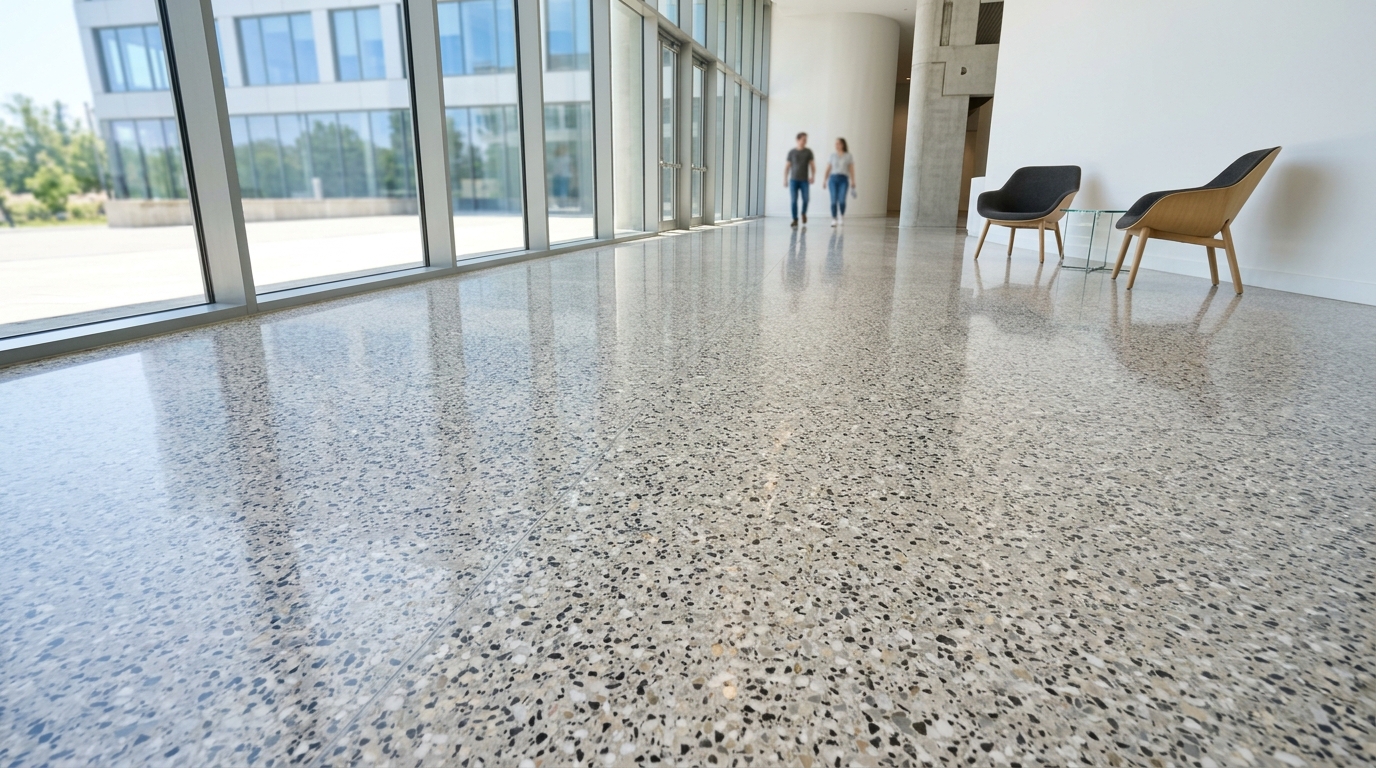
Non-porous terrazzo flooring is an engineered surface material designed to eliminate microscopic voids, preventing liquids, oils, and chemical contaminants from penetrating the matrix. By combining high-density aggregate formulations with advanced hydraulic pressing and industrial sealants, modern precast terrazzo tiles achieve near-zero water absorption (typically below 0.5%). This non-porous structure delivers exceptional hygiene, stain resistance, and mechanical strength, making it the preferred flooring specification for high-traffic commercial hubs, healthcare centers, educational campuses, and corporate headquarters requiring long-term lifecycle performance.
Understanding Porosity in Architectural Flooring
Porosity refers to the open capillary network within a flooring material through which liquids, gases, and micro-particles can travel. Standard natural stone and unsealed concrete feature interconnected pores that absorb moisture, organic stains, and industrial chemicals, leading to internal degradation, efflorescence, and bacterial growth.
Engineered non-porous terrazzo overcomes these vulnerabilities through controlled factory manufacturing processes. By subjecting fine marble, granite, or quartz aggregates bound with high-grade cementitious matrix to vacuum compaction and severe mechanical pressing, air pockets are evacuated. The resulting surface matrix impedes liquid ingress, ensuring that spills remain entirely on the surface where they can be easily remediated without permanent staining.
Core Features of Non-Porous Terrazzo Flooring
Specifying non-porous terrazzo for commercial architecture provides distinct structural and operational advantages over conventional porous surfaces. Key characteristics include:
- Exceptional Hygiene and Microbe Resistance: Without open capillaries or grout voids, bacteria, mold, and fungi cannot colonize inside the material. This non-porous quality fulfills stringent sanitation standards required in medical facilities, laboratories, and food handling environments.
- Chemical and Stain Immunity: Resistance to acidic food spills, grease, vehicle fluids, and aggressive cleaning solutions prevents discoloration, etching, and surface pitting over decades of use.
- High Compressive and Flexural Strength: Densified precast terrazzo blocks and tiles resist extreme point loads, heavy rolling machinery, and constant foot traffic without cracking or spalling.
- Thermal and Moisture Stability: Because moisture cannot penetrate the internal structure, non-porous terrazzo is protected against freeze-thaw cracking, sub-floor moisture vapor emissions, and internal delamination.
- Simplified Maintenance Regimen: Eliminating the need for frequent deep-stripping, re-waxing, or invasive chemical treatments significantly reduces operational cleaning expenditures.
Precast Engineering vs. Traditional In-Situ Application
While traditional poured-in-place terrazzo is polished on site, achieving a uniform non-porous density depends heavily on site conditions, ambient humidity, and manual troweling. In contrast, engineered solutions like Topaz Precast elements are manufactured under strictly monitored factory parameters.
Controlled curing environments ensure optimum hydration of cementitious binders and uniform aggregate dispersion. When reviewing technical specifications on our Technical Specifications Table, architects and structural engineers can verify exact density parameters, flexural limits, and abrasion performance metrics that guarantee zero structural permeability before installation even begins.
Performance Comparison: Commercial Flooring Surfaces
Choosing the right floor finish for large-scale enterprise projects requires evaluating material characteristics under rigorous daily demands. The comparison table below highlights how non-porous precast terrazzo performs against traditional commercial alternatives:
| Property / Feature | Non-Porous Precast Terrazzo | Natural Marble / Granite | Standard Commercial Vinyl (LVT) |
|---|---|---|---|
| Water Absorption | < 0.5% (Non-Porous) | 1.0% – 5.0% (Porous) | Impermeable (Surface only) |
| Stain & Chemical Resistance | High (Resists oils & acids) | Low to Moderate (Prone to etching) | Moderate (Prone to chemical scuffing) |
| Lifecycle Expectancy | 40+ Years | 20–30 Years | 7–10 Years |
| Maintenance Demand | Low (Neutral cleaning) | High (Frequent sealing) | Moderate (Stripping & recoating) |
| Point Load Capacity | Extreme (>60 MPa) | Moderate to High | Low (Indentation risk) |
Technical Documentation and Architectural Standards
For large procurement projects and commercial tenders, verifying certified physical metrics is crucial. Non-porous terrazzo tiles must meet rigorous European (EN) and ASTM standards for slip resistance, abrasion resistance, and flexural strength under severe environmental loads. Specifiers can access full test reports, fire safety ratings, and material safety data via our official Technical Documents section to support green building certifications such as LEED and BREEAM.
Frequently Asked Questions
Does non-porous terrazzo require chemical sealants after installation?
While precast terrazzo manufactured with ultra-dense matrices inherently restricts absorption, applying a breathable, penetrating sealer after joint grouting provides an added hydrophobic protective shield against harsh micro-surface contaminants during construction handovers.
How does non-porous terrazzo respond to heavy vehicular traffic?
Due to its high compressive density and rigid aggregate structure, non-porous precast terrazzo withstands heavy point loads, such as forklifts, luggage carts, and maintenance vehicles, without surface cracking or indentation.
Can non-porous precast terrazzo be specified for exterior walkways?
Yes. Because the material prevents internal water absorption, it effectively resists freeze-thaw cycles that cause surface flaking in outdoor environments. Textured or bush-hammered surface finishes can be selected to maintain wet slip resistance.
Specifying the Optimal Terrazzo Solution for Your Project
Selecting the correct aggregate size, binder composition, and slip resistance profile depends directly on your facility's operational demands, foot traffic volume, and aesthetic goals. Evaluating sample tiles under real-world lighting and load conditions ensures that your architectural vision aligns perfectly with long-term performance realities. To discuss custom dimensions, project specifications, or request physical material samples, reach out directly to our engineering specialists via our Contact and Quotation Page.