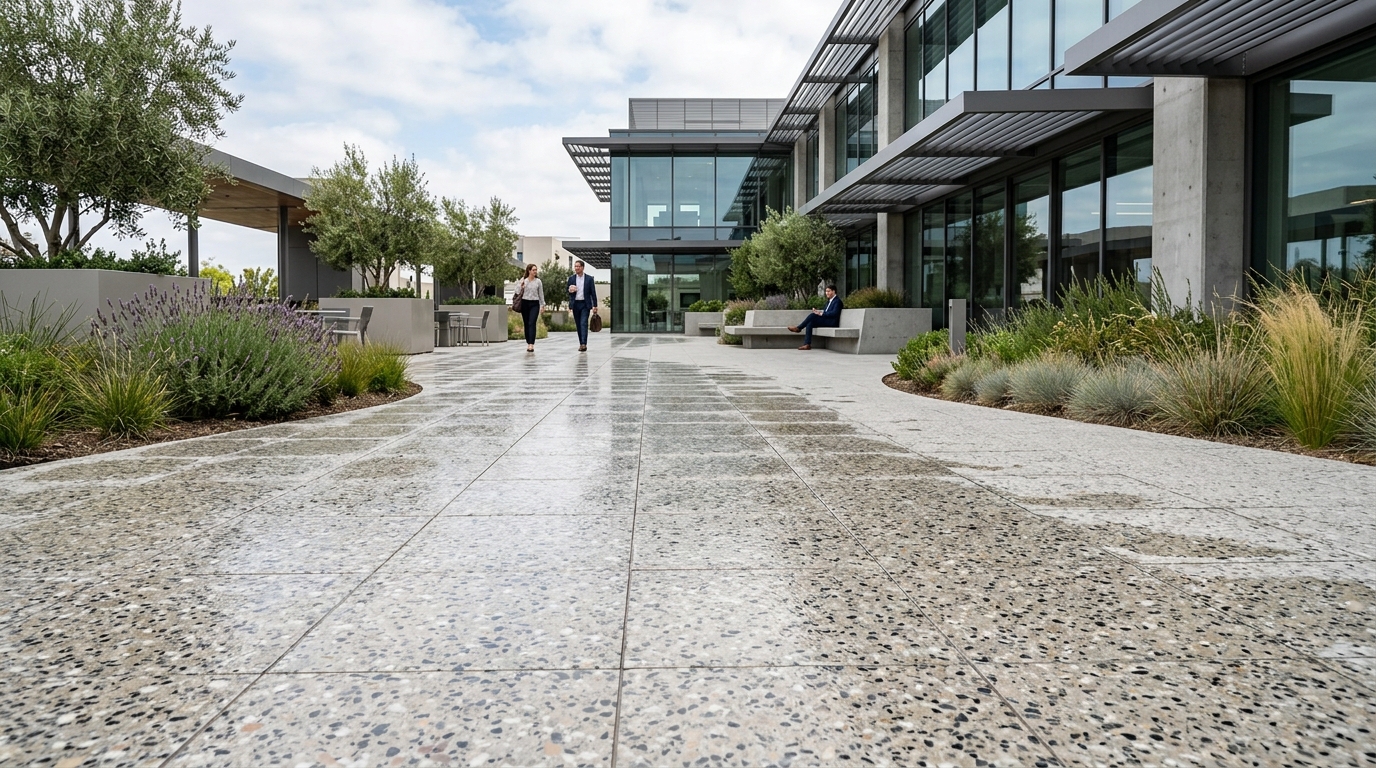
Outdoor terrazzo tile flooring provides commercial properties, urban plazas, and high-footfall public environments with a heavy-duty, aesthetically refined surface material. Manufactured by combining crushed marble, granite, or quartzite aggregates within a high-strength cementitious binder, precast outdoor terrazzo tiles deliver exceptional load-bearing capacity and resistance against severe environmental exposure. Engineered specifically to withstand freeze-thaw cycles, solar radiation, and mechanical wear, precast terrazzo offers architectural specifiers a durable alternative to natural stone and standard concrete pavers. Exploring specialized outdoor tiles allows project designers to integrate customized color palettes and aggregate distributions while maintaining rigorous structural standards.
Structural Advantages of Precast Terrazzo in Exterior Environments
Exterior architectural surfaces face persistent exposure to moisture ingress, temperature fluctuations, and heavy pedestrian or vehicle loads. Precast terrazzo flooring addresses these physical demands through controlled factory manufacturing, which ensures uniform compaction and consistent structural density across every unit.
- High Compressive Strength: Formulated with calibrated stone aggregates and dense cementitious matrices, precast tiles withstand heavy point loads without fracturing or cracking.
- Low Water Absorption: Vacuum-assisted pressing and precise hydration cycles reduce capillary pores, significantly limiting water absorption and protecting against frost damage.
- Dimensional Precision: Industrial production tolerances guarantee uniform thickness and crisp edges, facilitating tight joint layouts and smoother surface transitions.
- UV and Thermal Stability: Inorganic mineral pigments and natural aggregates maintain their color integrity despite prolonged sun exposure, resisting fading and surface degradation.
Key Technical Parameters: Slip Resistance, Load Bearing, and Thermal Endurance
Selecting the correct outdoor terrazzo tile flooring requires balancing aesthetic intent with hard technical metrics. Commercial decision-makers must evaluate surface texture, slip resistance ratings, and mechanical performance based on localized weather conditions and expected foot traffic.
| Technical Parameter | Standard Requirement / Target | Architectural Significance |
|---|---|---|
| Slip Resistance (DIN 51130) | R10 to R12 (Textured/Blasted) | Ensures safe pedestrian traction under wet outdoor conditions. |
| Flexural Strength | Class 1 to Class 3 (EN 13748-2) | Prevents structural failure under dynamic loading and ground settling. |
| Freeze-Thaw Resistance | Deicing salt resistant / Zero scaling | Protects structural integrity during winter freeze cycles. |
| Abrasion Resistance | Wide Wheel Abrasion (Class 4/H) | Resists surface wear caused by heavy foot traffic and ambient grit. |
Detailed performance metrics across various tile series can be reviewed in the official technical specifications table to match specific project loads and environmental classes.
Surface Finishes and Texture Options for Exterior Safety
Unpolished and textured surface treatments are critical when specifying terrazzo for exterior applications. While polished terrazzo remains popular for interior spaces, outdoor zones require textured profiles that disrupt water films and maintain adequate friction underfoot.
Shot-Blasted (Bushed) Finishes
Shot-blasting micro-textures the surface by firing fine steel abrasive media at high velocity against the set concrete. This process subtly exposes the embedded aggregates while creating a uniform, slip-resistant matte surface ideally suited for urban plazas, concourses, and shopping center walkways.
Washed Aggregate (Exposed Aggregate) Finishes
By removing the top surface paste before full curing, aggregate particles are left exposed to form a deeply textured tactile surface. Exposed aggregate terrazzo delivers superior anti-slip performance, making it an excellent choice for ramp inclines, public staircases, and wet perimeter zones.
Honed and Brushed Finishes
Honing provides a flat, low-sheen finish that offers a balance between tactile smoothness and adequate wet traction. When paired with mechanical wire-brushing, the surface achieves an antiqued, rich stone texture while retaining slip resistance suitable for covered entryways and outdoor courtyards.
Critical Installation Guidelines and Sub-Base Preparation
The long-term performance of outdoor terrazzo tile flooring depends heavily on proper sub-base engineering, substrate slope, and appropriate mortar selection. Inadequate site preparation remains the leading cause of cracking, efflorescence, and tile debonding.
- Sub-Grade and Concrete Base: Tiles must be laid over a fully cured, structurally sound reinforced concrete slab. The base must be free of dynamic cracks, oil, or loose debris.
- Drainage Slope: A minimum surface gradient of 1.5% to 2.0% (15-20 mm per meter) must be established away from structures to prevent standing water accumulation.
- Adhesive Systems: Flexible, polymer-modified cementitious tile adhesives (classified C2TE-S1 or C2TE-S2 under EN 12004) are required to absorb minor thermal movement between the tile and sub-slab.
- Expansion Joints: Perimeter movement joints and intermediate expansion joints must be placed every 4 to 6 linear meters, matching existing structural joints in the underlying concrete base.
For complete step-by-step guidance on surface bed preparation, bedding layers, and jointing details, refer to the published outdoor surface application and joint recommendations.
Life-Cycle Maintenance and Efflorescence Prevention
Outdoor terrazzo is inherently low-maintenance compared to natural stone paving or poured asphalt, but routine care preserves its color depth and structural surface integrity. Primary maintenance considerations include protecting joints and managing ambient moisture.
Efflorescence—a white powdery salt deposit that can migrate to the tile surface—is minimized by specifying low-alkali setting mortars, applying breathable silane/siloxane water repellents, and ensuring proper sub-base drainage. Routine cleaning should involve neutral pH soaps and stiff-bristled brooms. High-pressure washing may be utilized periodically, provided spray nozzles are kept at a safe distance to avoid eroding cementitious grout joints.
Frequently Asked Questions About Outdoor Terrazzo Flooring
Are precast terrazzo tiles suitable for sub-zero winter climates?
Yes. High-density precast terrazzo manufactured under controlled compaction has minimal water absorption, which prevents freeze-thaw expansion that leads to surface scaling or internal cracking.
What is the minimum recommended thickness for exterior terrazzo tiles?
For standard pedestrian areas, a tile thickness of 30 mm to 35 mm is typical. High-load zones subject to light maintenance vehicles or heavy urban traffic often require 40 mm to 50 mm thick precast units.
How does precast terrazzo tile differ from poured-in-place terrazzo outdoors?
Precast terrazzo tiles offer factory-controlled hydration, consistent physical strength, uniform aggregate distribution, and integrated expansion joints. Poured-in-place exterior terrazzo requires complex climate control during installation and is significantly more prone to random thermal cracking.
Can terrazzo tiles be installed using an elevated pedestal system?
Yes. Thick structural precast terrazzo tiles engineered for flexural strength can be installed on adjustable pedestal supports for raised terraces, balconies, and accessible roof decks, allowing rapid drainage beneath the surface.
Architectural Specification and Project Support
Selecting the optimal outdoor terrazzo tile flooring solution requires evaluating specific traffic density, environmental exposure, structural loads, and aesthetic intent. Topaz Precast manufactures high-performance architectural concrete and precast terrazzo elements tailored for commercial, municipal, and residential developments.
For custom aggregate selection, sample kits, technical specification documents, or direct project pricing consultations, reach out to our engineering team through our contact page to discuss your upcoming project requirements.