
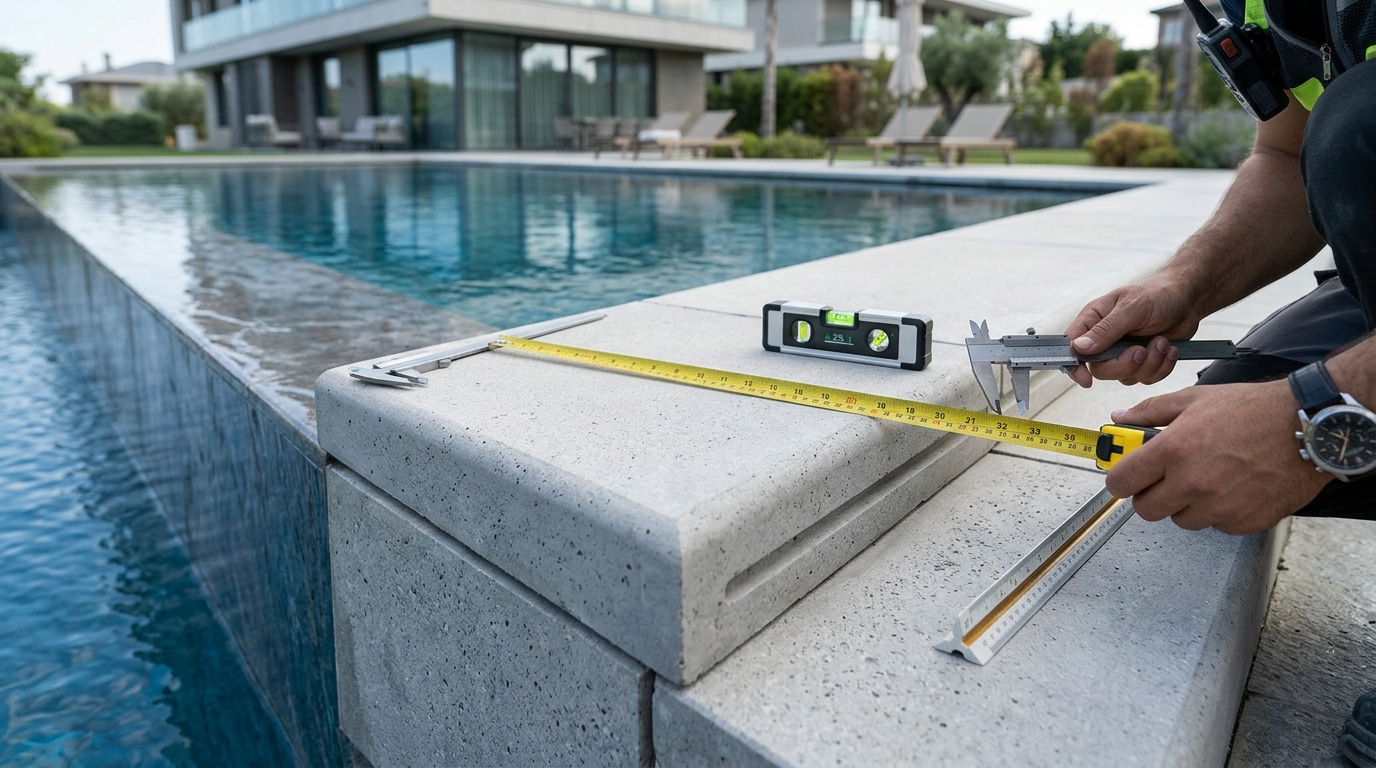
Standard precast pool coping dimensions typically feature widths ranging from 25 cm to 40 cm, unit lengths between 50 cm and 100 cm, and edge thicknesses from 3 cm to 6 cm. Determining the precise measurements for precast pool edge elements depends on the structural beam thickness, overflow channel layout, and aesthetic requirements of the facility. Selecting engineered architectural coping ensures superior water deflection, slip resistance, and thermal durability around commercial and residential pools.
Standard Dimensions for Precast Pool Coping Elements
Precast pool coping serves both a protective and aesthetic role, capping the pool shell bond beam while providing a secure edge for swimmers. To accommodate varying architectural plans, precast pool coping is manufactured in several standardized dimension profiles:
- Standard Coping Width: Ranges from 25 cm to 40 cm. The chosen width must cover the structural pool beam plus an intentional 2 cm to 4 cm overhang over the inner pool wall.
- Unit Length: Standard lengths are produced in 50 cm, 60 cm, and 100 cm segments. Longer units minimize visible mortar joints, creating a seamless visual outline around the pool perimeter.
- Element Thickness: Typically produced between 3 cm and 5 cm for standard flat profiles, extending up to 6 cm to 8 cm for drop-face (apron) architectural designs.
- Overhang and Drip Groove Depth: A 2 cm overhang with an integrated underside drip groove prevents splash backwater from seeping into wall joints.
For detailed dimensional variations across structural product lines, engineers and specifiers frequently consult specialized precast coping elements engineered for elevated mechanical strength and minimal water absorption.
Key Architectural Factors Influencing Dimension Selection
Selecting the right dimensions for pool coping requires evaluating the operational environment, hydraulic system type, and edge loading requirements. Precast concrete coping units must withstand heavy foot traffic, chemical exposure, and constant moisture without micro-cracking.
1. Pool System Type: Skimmer vs. Overflow Channels
In skimmer pools, coping units rest directly on top of the bond beam, requiring wider coping blocks (typically 30 cm to 35 cm) to extend inward over the tile line. In deck-level overflow pools, coping elements serve as the transition border between the pool basin and the drainage channel, often utilizing specialized bullnose or anti-slip profiled elements with integrated drainage pitch.
2. Edge Profiles and Safety Bevels
The profile geometry directly affects the effective thickness and outer dimension of the coping. Common edge finishes include:
- Bullnose Profile: Full rounded front edge (typically R=15mm to R=25mm) ensuring safe entry and comfortable grip.
- Flat with Beveled Edges: Clean, modern geometry featuring a 3mm to 5mm chamfered edge to prevent chipping under impact.
- Drop-Face (L-Shape): Features an extended vertical down-turn (apron) of 5 cm to 10 cm overhang, disguising the waterline beam joint.
Technical Specifications and Dimensional Tolerances
High-performance architectural precast coping must strictly adhere to physical tolerance standards to guarantee uniform alignment along long pool runs. Dimensional variances exceeding ±2 mm can cause uneven joint lines and hazardous tripping points.
| Coping Specification | Standard Measurement Range | Engineering Tolerances |
|---|---|---|
| Width (W) | 250 mm – 400 mm | ± 1.5 mm |
| Length (L) | 500 mm – 1000 mm | ± 2.0 mm |
| Edge Thickness (T) | 30 mm – 60 mm | ± 1.0 mm |
| Drip Groove Offset | 15 mm from outer edge | ± 1.0 mm |
| Joint Gap Recommendation | 5 mm – 8 mm flexible joint | N/A |
Architects and project engineers can review comprehensive physical parameters and stress performance metrics in the official technical specification tables to verify structural suitability for high-density public facilities.
Custom Precast Pool Edge Manufacturing Capabilities
While standard modular units satisfy conventional rectangular pool geometries, commercial water parks, hotel resorts, and architectural projects frequently demand custom-curved coping radiuses and non-standard widths. Custom architectural casting techniques make it possible to manufacture precise concave and convex radius coping segments that follow complex pool outlines perfectly.
By selecting specialized precast architectural elements, developers benefit from factory-controlled curing conditions, consistent batch coloring, and integrated surface texturing designed for superior wet-slip resistance (R11 rating or higher).
Installation Alignment and Joint Dimensioning Guidelines
Achieving a durable installation depends as much on correct joint spacing and mortar beds as it does on the precast unit dimensions. Below are crucial site preparation guidelines:
- Sub-Base Preparation: The concrete bond beam must be cured, clean, and level, allowing for a 10 mm to 15 mm high-strength adhesive mortar bed.
- Slope Gradient: Coping must be installed with a subtle 1% to 2% outward pitch away from the pool water, ensuring surface water drains toward peripheral deck drains.
- Movement Joints: Flexible polyurethane sealant joints of 5 mm to 8 mm width should be placed every 3 to 4 meters to accommodate thermal movement without cracking the coping units.
Optimizing Precast Edge Solutions for Commercial Projects
Choosing the correct precast pool coping dimensions ensures long-term structural integrity, reduced maintenance costs, and a polished aesthetic for any aquatic facility. Standardizing coping dimensions during the initial design phase simplifies procurement while ensuring uniform structural performance across all pool perimeters.
For bespoke architectural drawings, site-specific sizing advice, or customized precast coping production queries, consult the technical engineering support team at Topaz Precast to review your technical drawings and structural requirements.