
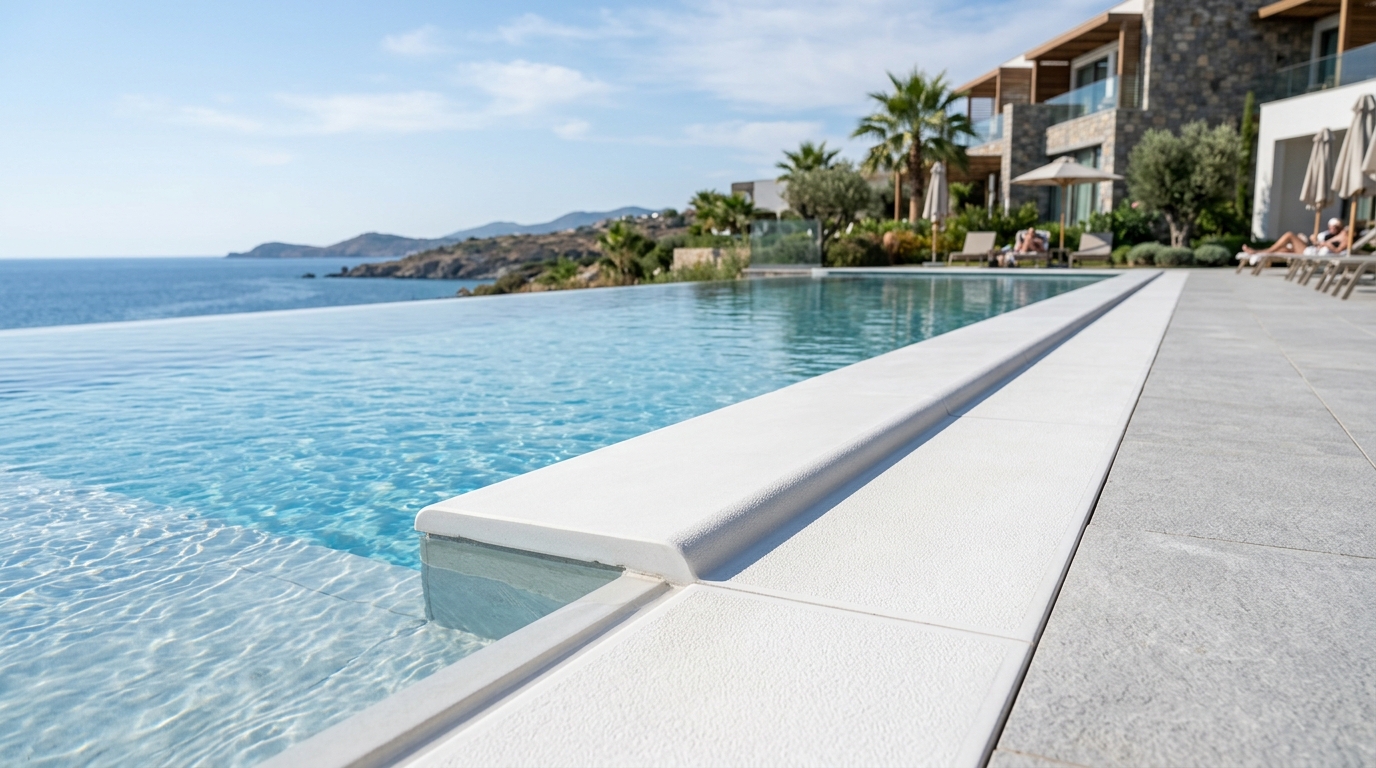
Architectural precast poolside coping and handrail elements provide the critical interface between water and walkway in modern commercial swimming pools. Engineered specifically for high-foot-traffic environments such as luxury hotels, wellness resorts, and sports facilities, precast concrete edge components integrate ergonomic handgrips, non-slip surface finishes, and exceptional structural resistance into a single cohesive profile. Unlike traditional natural stone or ceramic tile edging that can chip, wear unevenly, or become dangerously slick, high-density precast coping ensures long-term user safety, strict dimensional consistency, and outstanding resistance to water treatment chemicals and freeze-thaw cycles.
Structural Advantages of Architectural Precast Concrete in Pool Edges
Commercial pool surrounds face continuous exposure to chlorinated or saltwater pool chemistries, direct solar radiation, thermal expansion, and constant water immersion. Standard masonry or cut stone frequently suffers from surface erosion, efflorescence, and joint failure under these demanding conditions.
By utilizing specialized aggregate mixes, micro-reinforcement, and controlled steam curing, high-performance architectural precast concrete elements deliver superior mechanical density and exceptionally low water absorption. This low porosity prevents chemical penetration and salt crystallization within the matrix, eliminating the primary causes of spalling and cracking over time. Detailed performance metrics regarding density, compressive strength, and water absorption rates can be verified in our technical specifications guide.
Safety and Ergonomics: Integrated Handrails and Non-Slip Coping Profiles
Pool edge safety relies on two vital physical characteristics: tactile surface grip and ergonomic hand support. Precast manufacturing allows precise molding of integrated grip rails (tutamak) and comfortable rounded edge profiles (küpeşte) directly into the coping block, providing swimmers with an intuitive, secure handhold during pool entry and exit.
- Calibrated Anti-Slip Finishes: Surface textures such as micro-sandblasted, acid-etched, or honed terrazzo finishes achieve high slip resistance ratings (equivalent to R11–R13 DIN standards) even when fully wet.
- Smooth Ergonomic Radius: Molded curved contours eliminate sharp corners, reducing contact injury risks while maintaining a comfortable grasp for bathers of all ages.
- Effortless Water Shedding: Precision pitch gradients molded into the coping surface redirect splashes away from the deck, minimizing standing water buildup along pedestrian pathways.
Technical Comparison: Precast Coping vs. Traditional Pool Edge Materials
Choosing the right material for commercial pool surrounds requires balancing initial capital investment with long-term maintenance overhead. The table below illustrates how precast concrete compares against natural stone and ceramic tile solutions:
| Performance Criteria | Precast Concrete Coping | Natural Stone (Travertine/Granite) | Ceramic & Porcelain Edge Tiles |
|---|---|---|---|
| Slip Resistance (Wet) | High (Custom micro-textured finishes) | Variable (Requires frequent re-honing) | Moderate to Low (Glaze wear issues) |
| Dimensional Tolerance | Extremely Precise (±1mm factory control) | Inconsistent (Requires thicker mortar beds) | Precise (Limited thickness options) |
| Chemical & Salt Resistance | Superior (Dense mix design & sealers) | Susceptible to acid damage & pitting | High (Grout joints remain vulnerable) |
| Structural Durability | Monolithic high compressive strength | Prone to natural fissure cracking | Brittle under heavy impact loads |
| Customization Options | Unlimited profiles, colors & radii | Limited by quarry cutting constraints | Standard factory sizes only |
Design Flexibility, Integrated Overflow Systems, and Color Customization
Modern architectural concepts demand continuous visual transitions between wet zones and outdoor lounges. Precast manufacturing offers architects and developers limitless creative control through custom-blended aggregate mixtures, pigments, and specialized edge capping shapes.
Whether your project calls for sleek monochromatic minimalist profiles or rich, decorative aggregate terrazzo textures, precast elements can be tailored to match overall landscape architecture. Similar customization principles apply across related wall protection and edge capping elements, such as engineered precast coping and wall capping units, ensuring seamless design continuity across the entire site perimeter.
Installation Best Practices for Lasting Structural Performance
Even the highest quality precast poolside elements require proper installation methodologies to perform flawlessly across decades of commercial operation. Key steps include:
- Sub-Base Preparation: Ensuring a rigid, fully cured concrete beam structure free of structural deflections or chemical contaminants.
- Waterproof Bonding Mortars: Utilizing polymer-modified flexible adhesive systems engineered specifically for permanent water immersion and thermal movement.
- Expansion Joint Management: Installing elastomeric expansion joints at calculated intervals matching structural pool movements to prevent stress transfer.
- Surface Sealing: Applying penetrating hydrophobic sealers to preserve color consistency and simplify ongoing pool maintenance regimes.
For detailed engineering guidelines, joint layout diagrams, and material handling specifications, consult our comprehensive technical documentation portal.
Frequently Asked Questions About Precast Pool Edge Systems
Are precast pool copings compatible with saltwater chlorination systems?
Yes. High-density precast concrete manufactured with low water-cement ratios and specialized chemical additives exhibits superior resistance to salt-induced spalling and corrosion compared to natural limestone or standard field-cast concrete.
Can precast handrails and coping profiles be produced for curved or custom-shaped pools?
Absolute precision custom manufacturing allows precast coping units to be produced for any pool radius, freeform perimeter, or custom overflow channel design directly from architectural CAD files.
How do precast coping stones perform under extreme freeze-thaw winter conditions?
Because factory-cured precast concrete possesses minimal pore space for water absorption, water cannot expand inside the matrix during freezing temperatures. This guarantees long-term freeze-thaw durability without surface scaling or structural fracturing.
Specifying Precast Pool Edgings for Your Commercial Project
Selecting architectural precast coping and handrail elements guarantees that your pool environment meets international safety guidelines while providing a high-end luxury aesthetic that withstands years of intensive commercial use. Solid engineering at the edge prepares the ground for long-lasting, trouble-free facility management.
If you are designing a hotel pool, municipal aquatic facility, or high-end residential complex, contact our technical advisory team directly through our contact page to receive custom project consultations, CAD edge profiles, and detailed specification quotes.