
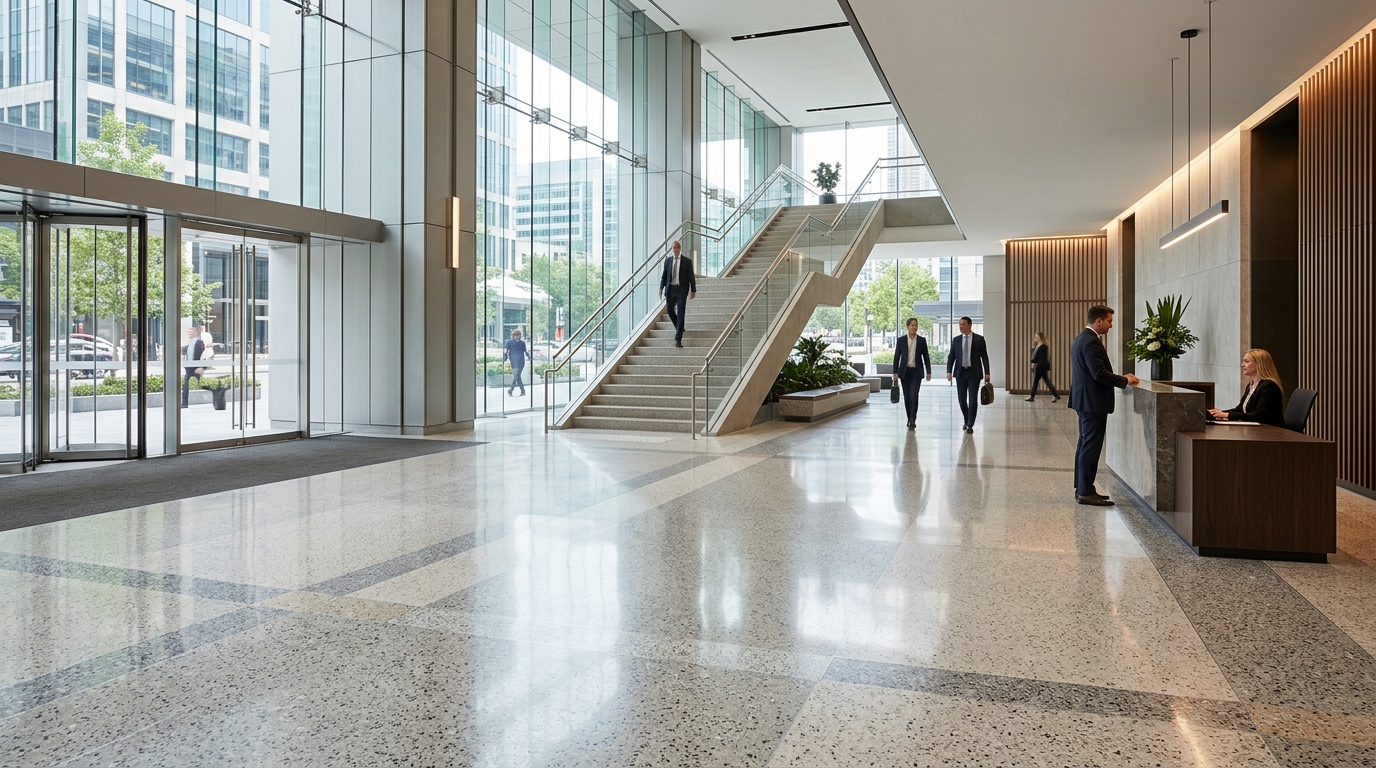
Commercial building entrances serve as the critical transition point between municipal urban space and corporate identity. Selecting prestigious tile solutions for commercial entrances requires balancing architectural aesthetics, extreme abrasion resistance, slip safety, and long-term lifecycle costs. Premium precast terrazzo and engineered stone tiles provide high compressive strength, customizable aggregate aesthetics, and exceptional resilience under heavy daily foot traffic.
Architectural First Impressions: Why Entrance Flooring Dictates Commercial Building Value
The primary entryway of a corporate headquarters, commercial plaza, or high-end retail facility establishes immediate brand perception. Flooring in these zones is subjected to continuous physical stress, soil intrusion, atmospheric moisture, and structural dynamic loads. A worn or cracked entrance floor signals neglect, whereas a pristine, custom-engineered terrazzo surface reinforces prestige and institutional trust.
High-end commercial properties require materials that retain aggregate clarity and color fidelity over decades. Natural stone slabs often suffer from inconsistent density and micro-fractures, while standard ceramic tiles lack the shock resistance required for heavy traffic. Engineered precast elements and terrazzo tiles deliver monolithic durability alongside refined aesthetic options.
Key Selection Criteria for High-Traffic Commercial Entrance Tiles
Specifying tiles for corporate entryways demands rigorous engineering evaluation. Architects and facility directors must assess several mechanical and environmental parameters before finalizing project specifications:
- Compressive and Flexural Strength: Entrance zones often handle unexpected vehicular loads, heavy maintenance machinery, and continuous foot traffic. High-density precast tiles offer superior resistance against cracking under point loads.
- Abrasion Resistance (Böhme Test Values): High footfall carries abrasive grit from outside. Low-abrasion materials show premature wear pathways within months, whereas high-grade aggregate matrix tiles preserve surface uniformity.
- Slip Resistance and Surface Finish: Exterior and covered entrance zones must meet safety standards under wet conditions. Finishes such as shot-blasted, brushed, or bush-hammered provide high Pendulum Test Values (PTV) without compromising tactile refinement.
- Thermal Shock and Freeze-Thaw Resistance: Exterior plazas and covered vestibules experience extreme temperature swings. Minimal moisture absorption prevents internal spalling during freeze-thaw cycles.
For detailed technical specifications and mechanical performance data across various material formulations, review the Technical Specification Table provided by Topaz Precast.
Terrazzo vs. Standard Concrete: Durability and Aesthetics in Executive Spaces
While standard poured concrete or basic paver blocks provide foundational utility, executive commercial spaces require elevated visual sophistication. Terrazzo technology combines select marble, granite, basalt, or glass aggregates within a high-strength cementitious binder, creating a dense material capable of polished or textured finishes.
| Property | Standard Concrete Pavers | Precast Terrazzo Tiles |
|---|---|---|
| Aesthetic Customization | Limited colors and uniform texture | Infinite aggregate blends, custom colors, and brass/zinc inlays |
| Flexural Strength | Moderate (4–6 MPa) | High (8–12+ MPa depending on formulation) |
| Surface Maintenance | Prone to staining and surface erosion | Dense surface; highly resistant to deep stain penetration |
| Lifecycle Expectancy | 10–15 years under high traffic | 30+ years with simple periodic repolishing |
Incorporating custom engineered precast elements into entry vestibules allows architects to maintain design continuity across horizontal flooring, vertical cladding, and custom stair transitions.
Managing Environmental Factors: Slip Resistance and Maintenance
Entrance design must account for rainwater carry-over, de-icing chemicals, and heavy soil loads. Incorporating transitional zone finishes—such as transitioning from a lightly textured exterior surface to a honed interior floor—creates a safe walk-off zone without sudden friction changes.
Proper cleaning protocols protect the cementitious matrix from acidic chemical damage. Facility managers should follow manufacturer guidelines regarding pH-neutral cleaners and protective sealants. Comprehensive material handling guidelines can be examined in our dedicated Technical Documents archive.
Step and Threshold Integration: Custom Precast Stairs and Curbs
Entrances rarely consist of flat horizontal planes alone. Staircases, raised landings, and curb transitions represent points of high mechanical stress and elevated fall risk. Standard cut tiles applied to step edges often chip at the arrises due to concentrated heel impacts.
Monolithic precast stair treads with integrated anti-slip grooves or contrasting aggregate nosings eliminate fragile grout joints at step edges. This architectural approach creates clean visual lines, ensures building code compliance, and provides structural integrity capable of withstanding heavy daily use.
Frequently Asked Questions
How do precast terrazzo tiles perform under heavy wheel loads such as luggage carts and maintenance vehicles?
Precast terrazzo tiles manufactured with high-density compaction and low water-cement ratios exhibit high compressive and flexural strength. When installed over a correctly engineered substrate with full-coverage mortar beds, they comfortably support luggage trolleys, mobility equipment, and light service vehicles without cracking.
What surface finish is recommended for outdoor commercial entrance ramps and steps?
For outdoor steps and exposed ramps, textured finishes such as shot-blasted, brushed, or fine-grooved surfaces are recommended. These finishes provide elevated slip resistance in wet weather while maintaining the rich visual texture of the internal natural stone aggregates.
Can precast tiles be customized to match existing corporate interior colors?
Yes. Cementitious precast terrazzo allows precise customization of background cement matrices using inorganic pigments combined with specific aggregate selections ranging from classic white marble to deep basalt or crushed granite.
Specifying Entrance Infrastructure for Your Next Commercial Project
Designing a prestigious commercial entrance requires early collaboration between architects, structural engineers, and precast manufacturing specialists. Selecting the optimal tile thickness, aggregate size, surface texture, and expansion joint layout during the design phase prevents costly retrofits during building operations.
To evaluate material samples, request customized technical drawings, or consult on project-specific entrance requirements, reach out directly via our Contact and Quote Request Page to engage with our engineering team.