
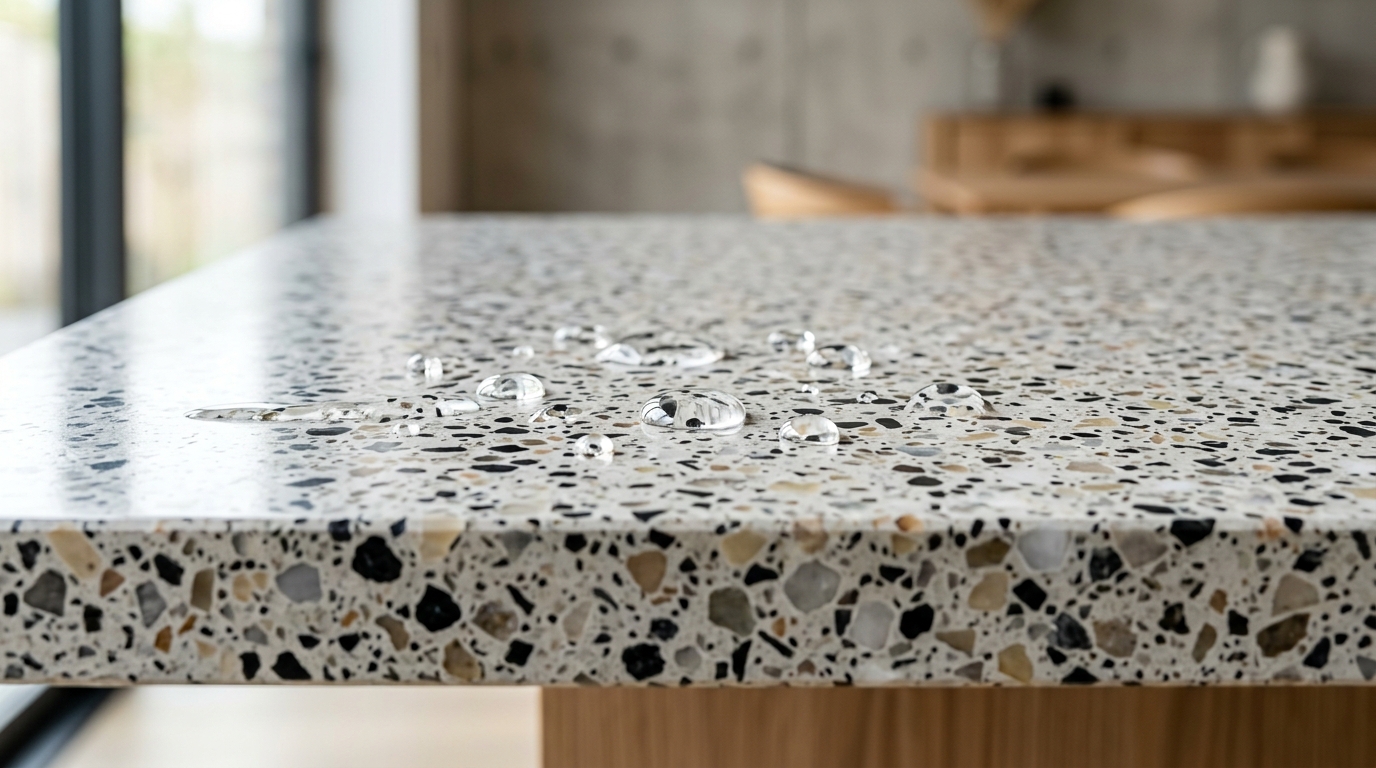
High-performance precast terrazzo tiles are widely specified for commercial hubs, transportation terminals, and institutional facilities due to their superior physical resilience and design flexibility. A primary technical metric governing this performance is the terrazzo tile water absorption rate, which typically ranges between 2% and 6% for high-density cementitious formulations and can drop below 0.5% in specialized resin-bound systems. A lower water absorption percentage directly correlates with elevated compressive strength, outstanding freeze-thaw resistance, and robust defense against deep staining or chemical degradation over decades of continuous foot traffic.
Understanding Water Absorption in Terrazzo Tiles
Water absorption indicates the volume of pore space within a material that can absorb water under atmospheric pressure. In cementitious precast terrazzo, this metric is dictated by the ratio of cementitious binder to aggregate, the grading of decorative stone chips (marble, granite, quartz), and the compaction force applied during production.
When a terrazzo tile exhibits high porosity, liquid easily penetrates the inner matrix. In commercial environments, absorbed water acts as a carrier for dirt, salts, and acidic chemicals. Over time, capillary action drives these elements deep into the tile, triggering efflorescence, sub-surface staining, and structural micro-cracking. Conversely, low-porosity terrazzo engineered through hydraulic pressing and vacuum vibration prevents fluid migration, safeguarding the structural integrity of the floor assembly.
How Low Water Absorption directly Boosts Durability
Structural durability in architectural flooring is not merely about surface hardness; it represents resistance to mechanical wear, environmental stresses, and dynamic load cycling. Lowering the water absorption rate enhances key physical properties:
- Compressive and Flexural Strength: Densified terrazzo matrix structures with minimal internal void space can support high concentrated static loads and rolling traffic without cracking.
- Abrasion and Impact Resistance: Dense aggregate packing prevents grit and debris from dislodging aggregate chips, preserving surface flatness under heavy footfall.
- Stain and Chemical Resistance: Impenetrable surfaces limit the absorption of oils, acidic cleaners, and food spills, reducing long-term maintenance costs for commercial facilities.
- Dimensional Stability: Low moisture intake prevents expansion and contraction cycles that lead to tile warping or joint grout failure.
For detailed engineering thresholds and load capacity ratings, architects and project managers can consult our comprehensive technical specification table.
Freeze-Thaw Resistance in Outdoor and Semi-Exposed Applications
For exterior plazas, transit hubs, and semi-exposed walkways, water absorption is the single most critical factor defining freeze-thaw durability. When absorbed water freezes, it expands by approximately 9% in volume. In porous tiles, this hydraulic expansion creates internal tensile stresses that exceed the material's rupture modulus, leading to surface spalling, micro-fracturing, and eventual delamination.
By specifying high-density precast terrazzo with low water absorption, specifiers ensure that remaining capillary voids are too fine or isolated to hold free-freezing water. This structural engineering detail eliminates internal freeze-thaw pressure, allowing outdoor installations to withstand severe winter climates without suffering material degradation.
Technical Performance Comparison Matrix
Evaluating material metrics side-by-side helps structural engineers and project planners select the right surface elements for high-stress zones:
| Material Type | Avg. Water Absorption Rate | Flexural Strength | Freeze-Thaw Suitability | Primary Application Area |
|---|---|---|---|---|
| High-Density Precast Terrazzo | 2.0% - 4.5% | High (> 5.0 MPa) | Excellent | Airports, Malls, Transit Terminals |
| Standard Cast-in-Place Concrete | 5.0% - 8.0% | Moderate (3.0 - 4.5 MPa) | Moderate | Industrial Floors, Sidewalks |
| Natural Marble Slabs | 0.5% - 2.0% | Variable (3.5 - 6.0 MPa) | Fair to Moderate | Low-Traffic Interiors, Wall Cladding |
| Unsealed Standard Cement Tiles | 6.0% - 10.0% | Low to Moderate | Poor | Light Residential Interiors |
To verify test protocols, fire classification, and technical compliance sheets for commercial procurement, review our updated technical documentation downloads.
Selecting Terrazzo Elements for High-Traffic Commercial Projects
When engineering durable commercial spaces, selection criteria must align material specifications with environmental exposure:
1. Compaction and Curing Standards
Factory-manufactured precast terrazzo tiles benefit from controlled hydraulic compaction and humidity-controlled curing rooms. This controlled environment reduces micro-porosity far more effectively than on-site poured terrazzo systems, achieving uniform water absorption rates across the entire batch.
2. Aggregate Density and Grading
Using well-graded marble or quartz aggregates ensures that smaller fines fill the interstitial spaces between larger chips. This tight matrix packing minimizes cement binder voids where water could otherwise collect.
3. Integrated Surface Sealing
While low bulk porosity provides structural protection, applying penetrating fluoropolymer or lithium silicate sealers provides an additional hydrophobic barrier at the wear layer. This treatment prevents liquid entry into surface pores while allowing vapor breathability from the subfloor.
Projects utilizing custom architectural components like stair treads, wall skirtings, and kerbs can explore tailored custom precast terrazzo solutions to maintain uniform durability across all architectural surfaces.
Frequently Asked Questions
What is considered an ideal water absorption rate for commercial terrazzo tiles?
For heavy commercial indoor and outdoor flooring, a water absorption rate under 4.0% according to standard EN test methods is highly recommended. Values below this limit guarantee strong resistance to dynamic physical loads and freeze-thaw cycles.
Can sealers completely fix a high-porosity terrazzo tile?
Sealers protect the immediate surface layer from spill penetration, but they cannot alter the internal matrix density of a poorly compacted tile. If the underlying body has high water absorption, moisture from the subfloor can still cause internal efflorescence or freeze-thaw failure.
Does aggregate selection impact terrazzo water absorption?
Yes. Non-porous aggregates like quartz, granite, or dense marble reduce overall tile absorption compared to softer, porous limestone aggregates. Aggregate grading and cement ratio are equally crucial.
Optimizing Technical Specifications for Long-Term Value
Prioritizing low water absorption and high structural density during the specification phase ensures long-term operational performance, lower life-cycle maintenance costs, and preserved aesthetic appeal. Commercial facility decision-makers, architects, and structural specifiers seeking project-specific testing data, tailored mix designs, or custom architectural element quotes are invited to reach out to our engineering team for technical consultation.